Menu

Author Archives: Equity Right

ONGC Q1 FY26 Results: Profit Growth Amid Revenue Decline

ONGC Q1 FY26 Results: Profit Growth Amid Revenue Decline

ONGC Q1 FY26 Results: Profit Growth Amid Revenue Decline

ONGC’s Resilient Performance Defies Headwinds, Showcases Strength of India’s Energy Backbone

Introduction: ONGC Proves Its Mettle Amid Uncertain Markets
As India’s foremost oil and gas producer, ONGC’s Q1 FY26 results have become a litmus test for the sector’s resilience. Despite facing volatile global crude prices and subdued revenues, ONGC propelled its consolidated profit up by a robust 18.2%. Strategic operational shifts, disciplined cost management, and new high-margin ventures have provided a strong buffer—reinforcing ONGC’s role at the heart of India’s energy security.

Financial Snapshot: Profit Up, Revenue Slips
• Consolidated PAT stood at ₹11,554 Crs, an 18.2% increase year-on-year.
• Consolidated revenue came in at ₹1,63,108 crore, reflecting a 3.5% decline from the previous year.
• Standalone net profit was ₹8,024 crore, down 10.2% year-on-year, impacted by global crude pricing pressures.
• Standalone revenue stood at ₹32,003 crore, down 9.3% compared to Q1 FY25.
The divergence between profit and revenue is primarily due to a mix of higher-margin sales, cost rationalization, and a strong boost from new well gas production fetching premium prices.

Oil & Gas Realizations: Market Trends and Monetization Strategies
• Crude oil realization (nominated fields): US$66.13 per barrel (down ~20% YoY), signaling continued softness in benchmark global oil prices.
• Joint venture oil realization: US$67.87 per barrel, also experiencing double-digit YoY contraction.
• Natural gas price (nominated): $6.64 per mmbtu, slight improvement from previous cycles.
• Premium gas sales: New well gas fetched $8.26 per mmbtu—a full 20% premium over domestic administered pricing—contributing ₹1,703 crore in revenue and boosting overall profitability by ₹333 crore compared to vanilla APM gas pricing.
Despite the drop in crude prices, higher contribution from new gas wells insulated ONGC’s margins and broadened its earnings mix.

Production Performance: Output Gains and Exploration Update
• Standalone crude oil production: Rose 1.2% YoY to 4.683 million metric tonnes (MMT), reversing prior-year stagnation.
• Standalone natural gas production remained steady.
• Joint venture (JV) production: Remained soft, fitting industry trends.
ONGC’s focus on technological upgradation and Brownfield enhancements helped inch up output, while two new offshore discoveries during the quarter underscore a fresh phase of domestic resource development.

Strategic Initiatives: Tapping Future Growth
• New Ventures: ONGC commenced production at its PY-3 field JV and began gas sales from Bokaro’s CBM block in Jharkhand.
• Network Integration: Gas supply from Tripura’s Palatana plant began servicing city networks, boosting downstream and retail prospects.
• Exploration Success: Two new offshore discoveries in Q1 FY26 promise to fortify ONGC’s reserves and support sustainable future output.

Market Reaction and Analyst Notes
• Stock performance: ONGC’s shares were in focus, reflecting the complex interplay of profit growth and revenue contraction. Investors reacted positively to higher profits, but concerns lingered regarding sustained global weakness in crude pricing.
• Brokerage views: The results were termed a “mixed bag”: strong profits from cost discipline and premium gas, weighed by lower core revenues and flattening oil benchmarks.

Challenges & Opportunities
• Global Price Volatility: While ONGC’s hedging and premium gas sales shielded profits, the company remains exposed to unpredictable crude price swings.
• Revenue Mix Shift: Growing proportion of higher-value gas sales suggests a strategic turn toward diversified, high-margin segments.
• Production Targets: Incremental gains in oil output counter underlying JV declines; ongoing field enhancements will be critical for future growth.
• New Discoveries: Recent successful wells could become foundation stones for ONGC’s next growth phase.

Conclusion: ONGC’s Adaptability Sets Tone for Sector
ONGC’s Q1 FY26 demonstrates that adaptability, operational discipline, and strategic market positioning can steer even legacy energy giants through challenging cycles. With profits at record highs and new discoveries on the horizon, ONGC is poised for medium- to long-term growth. Nevertheless, vigilance over global commodities and continued investment in technological innovation remain imperative for future leadership.


:


The image added is for representation purposes only

Tilaknagar Industries Q1 FY26: Profit Soars Amid Expansion Plans

Tilaknagar Industries Q1 FY26: Profit Soars Amid Expansion Plans

Tilaknagar Industries Q1 FY26: Profit Soars Amid Expansion Plans

Tilaknagar Industries Q1 FY26: Profit Soars Amid Expansion Plans

Leading Indian IMFL maker posts record quarterly earnings with robust volume growth and strategic acquisition plans

Financial Performance Overview: Q1 FY26
Tilaknagar Industries Limited, renowned for its flagship brand Mansion House Brandy and as one of India’s leading IMFL producers, unveiled an outstanding set of results for the quarter ended June 30, 2025. Consolidated revenue rose 30.6% year-on-year to about ₹409 crore, up from ₹313 crore in the corresponding quarter last year.
Adjusting for a government subsidy of ₹38.6 crore, revenue still recorded a robust growth of 20.5%, underscoring genuine demand strength. Volume growth was equally impressive, with shipments rising 26.5% YoY to 32.1 lakh cases, marking the highest quarterly volume since FY15 and highlighting the company’s successful penetration and market expansion efforts.

Profitability Rockets on Margin Expansion
Tilaknagar Industries’ profitability mirrored its top-line momentum. EBITDA soared by an exceptional 88%, touching ₹94.5 crore compared to ₹50.2 crore a year ago. EBITDA margin jumped to 23.1%, an increase of 700 basis points from 16% in Q1 FY25.
Even excluding the subsidy impact, EBITDA grew by 25%, affirming that operational efficiency and cost discipline were significant contributors to this margin enhancement.
Net profit after tax (excluding exceptional items) more than doubled, increasing by 120.8% to ₹88.5 crore, up from ₹40.1 crore in Q1 FY25. This translated into a healthy earnings per share (EPS) of about ₹4.54 per share, more than doubling from the previous year.

Volume Growth and Market Share Gains
Chairman and Managing Director Amit Dahanukar highlighted the quarter as a period of strong, consistent growth that outpaced the industry for Tilaknagar Industries. The company experienced notable market share improvement in each key region, particularly in the southern states, where demand grew robustly.
Volume gains were central to the company’s growth story, driven by widening distribution, stronger brand acceptance, and strategic pricing moves. Though price reductions in specific states like Andhra Pradesh impacted topline growth compared to volume, the overall contribution remained positive, supporting sustainable growth.

Strategic Expansion and Acquisition Moves
Tilaknagar is actively investing in capacity expansion and inorganic growth to strengthen its competitive positioning. The Board approved a ₹25 crore capital expenditure to boost bottling capacity at its Prag Distillery subsidiary in Andhra Pradesh, scaling from 6 lakh to 36 lakh cases annually.
Meanwhile, Tilaknagar is advancing its transformative acquisition of Pernod Ricard India’s Imperial Blue brand business, valued at about €413 million (₹4,150 crore).
This acquisition, currently pending Competition Commission of India (CCI) approval expected by the end of 2025, will add substantial premium brand value, broaden the product portfolio, and significantly bolster market presence.

Investor Response and Market Outlook
Following the results announcement, Tilaknagar Industries’ shares rose as much as 6% intraday and ended the session close to ₹500. The market welcomed the combination of strong financial performance and bold growth initiatives.
Management’s forward-looking statements indicate confidence in maintaining volume momentum and scaling profitability by capturing rising consumer preference trends and expanding into high-growth states.

Challenges and Considerations
While the results are encouraging, the company faces typical sector challenges including:
• Regulatory environment and state-specific policy shifts impacting liquor pricing and availability.
• Competition from both established players and emerging regional brands.
• Execution risks related to integration and synergies from the Imperial Blue acquisition.
• Sustaining margin expansion amid input cost fluctuations.
However, Tilaknagar’s strong cash position, demonstrated by net cash of ₹163 crore as of June 2025, and strategic investments position it well to navigate these hurdles.

Conclusion: Positioned for Industry Leadership
Tilaknagar Industries’ Q1 FY26 performance highlights the success of its growth strategy, driven by higher volumes, stronger margins, and bold expansion initiatives.
The company’s robust financial footing enables it to pursue acquisition-driven growth, capitalizing on emerging premiumization trends in the Indian IMFL sector.
If the anticipated acquisition gains regulatory clearance and volume momentum continues, Tilaknagar could cement its leadership among India’s top liquor producers. The blend of organic and inorganic strategies bodes well for sustained value creation and competitive differentiation.


:


The image added is for representation purposes only

Shalimar Paints Q1 FY26: Losses Reduce as Revenue Climbs

Market Share Tussle in Paints Enters Next Level

Shalimar Paints Q1 FY26: Losses Reduce as Revenue Climbs

Shalimar Paints Q1 FY26: Losses Reduce as Revenue Climbs

Fresh strategies help Shalimar Paints limit losses while driving double-digit revenue growth in the June 2025 quarter

Performance Snapshot: Q1 FY26
Shalimar Paints, one of India’s oldest and best-known paint manufacturers, delivered a promising set of financials for the first quarter of FY2025-26. The company reported a revenue jump to approximately ₹153-177 crore—a YoY increase of nearly 20%. The results highlight the company’s renewed push for market share and cost optimization, as well as strong demand in both decorative and industrial paint categories.
The June 2025 quarter saw Shalimar Paints cut its consolidated net loss to around ₹16.7 crore, compared to a much steeper ₹27 crore loss posted a year earlier. This represents an improvement in the company’s operational efficiency and points to successful cost-control initiatives rolled out in the past twelve months.

Revenue Grows on Back of Market Expansion
Buoyed by enhanced dealer penetration, aggressive marketing efforts, and a wider product portfolio, Shalimar Paints’ sales climbed steadily through the quarter. The decorative paints segment benefited from robust demand in the housing and renovation sector, while the industrial paints division also saw healthy offtake as infrastructure and manufacturing activities nationwide picked up pace.
Revenue for the quarter increased by approximately 19-23% YoY, depending on the reporting source. This outpaced industry averages and signaled the effectiveness of the management’s tactical shift towards volume-led growth and premiumization of offerings.

Cost Discipline Drives Operating Results
Management focus on cost rationalization and operational efficiencies started to pay off during Q1 FY26. The company reported significant improvements in operating profit, with some reports showing operating profit more than doubling when compared to the previous year.
While the bottom line is still in red, the operating margin improved as efforts such as better raw material sourcing, supply chain enhancements, and prudent expense control bore fruit. These measures helped protect margins in the face of fluctuating raw material prices and high competitive intensity from larger rivals.

High Debt Remains a Hurdle
Despite noticeable progress, Shalimar Paints continues to grapple with high finance costs and rising borrowing levels. Interest expenses rose, further undermining net profit and prolonging the company’s struggle to return to profitability. The negative operating margin, although reduced from prior levels, still reflects the heavy debt burden the company must overcome to deliver shareholder value.

Investor Sentiment: Cautious Optimism
Analysts and investors responded positively to signs of recovery. The reduced losses suggest that Shalimar Paints’ restructuring and revival strategies are starting to deliver results. However, skepticism remains due to ongoing losses and the challenges posed by large debt and competitive pressures in the paints sector.

Conclusion: Signs of a Turnaround, but Road Ahead Is Long
Shalimar Paints made noticeable progress in the first quarter of FY2025-26. A sharp revenue increase and significant reduction in net loss echo the management’s determination to revive the brand and restore financial stability. Nonetheless, persistent net losses highlight the urgent need for continued improvement in cost structure and debt management.
If Shalimar Paints succeeds in boosting profitability and further trimming losses in the upcoming quarters, it could solidify a full-fledged turnaround. For now, the Q1 FY26 results offer hope—but warrant cautious optimism until sustained profits emerge.


:


The image added is for representation purposes only

Alpex Solar Q1 FY26: Stellar Growth Pushes Company to New Peaks

Alpex Solar Q1 FY26: Stellar Growth Pushes Company to New Peaks

Alpex Solar Q1 FY26: Stellar Growth Pushes Company to New Peaks

Alpex Solar Q1 FY26: Stellar Growth Pushes Company to New Peaks

Demonstrating explosive revenue and profit surges, Alpex Solar shows robust operational momentum backed by strategic capacity expansions

Financial Performance Overview: Q1 FY26
Alpex Solar Ltd posted outstanding unaudited consolidated results for the quarter ended June 30, 2025, showcasing a remarkable turnaround fueled by soaring sales and improved operational efficiency.
The company reported revenue from operations of approximately ₹380.32 crore, marking an astonishing 395.7% increase compared to the same quarter last year.
Profitability indicators were even more impressive. PAT jumped an astounding 3,888% to ₹42.29 crore from ₹1.06 crore in Q1 FY25, while EBITDA soared 1,058% to ₹57.39 crore, reflecting significant margin gains and effective cost management.
The company’s basic earnings per share (EPS) ballooned to ₹17.28, a substantial leap from ₹0.43 share a year earlier, signaling enhanced shareholder value and operational leverage.

Capacity Expansion Driving Growth Ambitions
Aligned with its aggressive growth strategy, Alpex Solar’s Board approved a capital expenditure of ₹110 crore to establish a new 1.2 GW solar module manufacturing facility at Kosi Kotwan, Uttar Pradesh. This plant is slated for commissioning in FY 2026-27 and will augment the company’s total manufacturing capacity to 3.6 GW—including 1.2 GW currently operational at Unit I, and an upcoming 1.2 GW facility expected in FY 2025-26.
This expansion plan reflects Alpex Solar’s commitment to meeting rising global and domestic demand for high-efficiency solar modules. The new capacity is expected to enhance input cost efficiencies, support larger scale production, and enable the company to compete effectively with international manufacturers.

Market Dynamics and Operational Strength
Alpex Solar’s explosive growth comes amid a favorable policy environment promoting renewable energy adoption in India and worldwide. Government incentives, ambitious solar capacity installation targets, and increasing corporate sustainability commitments fuel demand for solar technologies.
The company reported strong sales growth led by both volume expansion and improved selling prices, underscoring effective market penetration and premium product positioning. Higher realizations per unit reflect advancements in module efficiency and the ability to command better pricing in competitive markets.
Additionally, stringent cost management and supply chain optimization helped Alpex significantly expand operating margins despite global supply chain pressures.

Sustainability and Future Outlook
Alpex Solar’s operational success dovetails with the global energy transition toward clean sources. With an industry-leading capacity scale-up strategy and technological investments, the company expects to sustain revenue and profit growth in coming years.
Leadership reaffirmed the focus on:
• Accelerating capacity augmentation to capitalize on growing demand.
• Advancing module efficiency and innovation to maintain competitiveness.
• Expanding export markets alongside domestic sales.
• Leveraging government schemes and policy frameworks supporting renewable energy.
The strong order book and ongoing product development pipeline position Alpex Solar as a key player in the Indian and global solar sectors.

Conclusion: Onward and Upward in Solar Energy Leadership
Alpex Solar’s standout Q1 FY26 results mark its emergence as a leading force in solar manufacturing.
The near quadrupling of revenues and nearly 40-fold profit growth underscore operational excellence and market acceptance.
With aggressive capacity expansions and a strategic vision aligned with global clean energy trends, Alpex is poised for sustained momentum. The company’s trajectory points toward expanding market share, enhanced technological capabilities, and deepened stakeholder value.
While solar markets remain dynamic, Alpex Solar’s robust execution and financial strength provide a solid foundation to capitalize on the surging demand for sustainable energy solutions in India and worldwide.


:


The image added is for representation purposes only

INOX Green Share Price Surges After Sealing 182 MW Wind O&M Deal

HFCL Shares Zoom 5% as Firm Secures 1,000 Acres for Defence Facilities

INOX Green Share Price Surges After Sealing 182 MW Wind O&M Deal

INOX Green Share Price Surges After Sealing 182 MW Wind O&M Deal

1. Market Reaction at a Glance
On August 12, 2025, Inox Green’s shares saw a notable uptick across key exchanges:
• According to Business Standard, the stock touched its daily upper limit of 5% during intraday trading on the BSE, reaching ₹163.4.
• The Economic Times reported a sharp rise to ₹163, up nearly 5%, as markets reacted to the new O&M agreement.
• Moneycontrol recorded a 3.6% gain, with the shares quoting at ₹161.25 in early trade.
• Meanwhile, Trade Brains pegged the increase at around 4.6%, placing the stock at ₹162.9 on BSE, compared to the previous close of ₹155.65.

2. Deal Structure and Scope
• The deal was finalized with the renewable energy division of a major Indian conglomerate.
• Covering wind assets located across Western India, the contract transitions 82 MW from limited-scope O&M to full O&M and renews 100 MW of full O&M earlier than planned.
• The agreement extends over the entire remaining lifespan of the assets.

3. What Inox Green’s Leadership Has to Say
Inox Green CEO SK Mathu Sudhana confirmed the milestone deal, highlighting that bringing their entire project fleet back into the company’s O&M ambit strengthens bonds with marquee clients and demonstrates growing customer confidence.
He added that this contract is emblematic of evolving trends in the wind O&M sector, and serves as validation of Inox Green’s upgraded capabilities.

4. Financial Impacts & Broader Context
• Business Standard (Capital Market News) confirmed the deal reinforces Inox Green’s standing as a trusted O&M provider, particularly after entering solar O&M earlier this year.
• Capital Market provided insight into Q4 FY25 earnings: while revenue jumped 30.4% to ₹68.38 crores, net profit dropped 73.9% to ₹5.56 crores compared to Q4 FY24.
• Trade Brains similarly shared these figures and noted that the Q1 FY26 financials will be discussed at the board meeting slated for August 14, 2025.

5. Immediate Implications & Outlook
• The agreement brings long-term revenue security, covering the full lifecycle of 182 MW, which should bolster investor confidence in recurring cash flows.
• The transition toward renewable energy, especially wind and solar O&M, positions Inox Green well amid energy sector evolution.
• However, the decline in profitability signals the need for efficiency improvements or margin support from new contracts.
• With upcoming board approval of Q1 results and growing expertise across both wind and solar O&M, Inox Green may be well-poised for future expansions.

Conclusion
Inox Green’s recent contract to operate and maintain 182 MW of wind assets marks a pivotal moment, signaling both resilience and adaptability. The surge in share price reflects the market’s positive reception to this testament of operational strength. As the company readies its Q1 financial report and continues diversifying into solar O&M, its future trajectory appears promising—provided it can navigate profit margin pressures while capitalizing on long-term O&M agreements.


:


The image added is for representation purposes only

Remsons Industries Q1 FY26: Consolidated Growth Powers Ahead

Bosch Ltd Q2 FY26: Auto Demand Boosts Sales, Profit Inches Up Despite Higher Costs

Remsons Industries Q1 FY26: Consolidated Growth Powers Ahead

Remsons Industries Q1 FY26: Consolidated Growth Powers Ahead

Financial Highlights: Q1 FY26
Remsons Industries, a leading Indian supplier of automotive cables and components, announced robust consolidated financial results for the quarter ended June 2025. Consolidated revenue surged to approximately ₹99.6 crore, reflecting a sharp 30% rise over the previous year. PAT surged 73% year-on-year, coming in at around ₹3.6 crore for the quarter.
Earnings per share also followed this growth trajectory, underscoring the company’s operational discipline and strong demand from global and domestic customers. At the same time, consolidated operating margins crept higher: EBITDA rose by 63% year-on-year, and a healthy 11% operating margin was reported.
However, standalone results painted a contrasting picture. Standalone revenues fell by nearly 8%, and standalone net profit slipped 11% year-on-year, primarily due to persistent softness in domestic core markets.

Strategic Expansion and New Ventures
Remsons’ management has pushed strongly into diversification and external partnerships to insulate it from domestic cyclical weaknesses. The company launched a new subsidiary, Remsons Edge Technologies Private Limited, and completed a significant (35.86%) minority acquisition in Astro Motors Private Limited. These bold moves aim to reinforce Remsons’ portfolio, boost R&D, and add new revenue streams, particularly through electric vehicle and high-value product segments.
Further, Remsons has aggressively broadened its product range and is steadily progressing on its stated ambition to venture into the railway and defense sectors—two markets with promising long-term potential.

Operational Excellence and International Push
Despite muted domestic auto sector trends during the quarter, Remsons outperformed its industry peers thanks to a blend of operational efficiencies, robust export growth, and a shift towards high-value, customized products. Management cited export realization and premium orders as critical drivers for consolidated revenue growth, particularly as overseas markets offered better pricing and stability.
Export growth and diversification not only cushioned against local market headwinds but also helped drive up profitability, as evidenced by the year-on-year expansion in margins.

Chairman’s Perspective: Confidence Amid Uncertainties
Chairman and Managing Director Krishna Kejriwal said the company’s strong results highlight its flexible and resilient business model.
He stressed that, even in a sluggish auto market, the company achieved remarkable results by advancing high-value segments, enhancing operational efficiency, and maintaining a firm focus on creating value for shareholders.
The company aims to reach a revenue milestone of ₹900–1,000 crore by FY29 as part of its medium-term goals. Management’s ongoing commitment to invest in technology, people, and process innovation remains central to this goal.

Challenges: Standalone Softness and Sectoral Risks
The main blemish in Q1’s performance was the dip in standalone revenue and profit. While the reasons include subdued demand from core Indian OEM clients and heightened competition, the company appears confident that its strategic pivots—such as moving further up the value chain and increasing export reliance—will help mitigate these headwinds moving forward.
Remsons also faces the broader cyclical risks affecting the auto sector, including input cost volatility, currency fluctuations, and changing regulatory norms. Nonetheless, its diversified base and strong cash position provide some insulation.

Conclusion: On Track for Ambitious Growth, with Cautious Optimism
Remsons Industries’ Q1 FY26 performance demonstrates the effectiveness of its transformation efforts and diversification into both product lines and geographies. Robust consolidated growth and margin expansion speak to improving competitiveness and operational focus. While soft spots remain in certain business verticals, particularly domestically, the company’s trajectory remains positive.
Management’s medium-term outlook is upbeat, grounded in investments in innovation, new business verticals, and continued global expansion. If Remsons sustains its strategic discipline, further market share gains and profitability improvements are likely.


:


The image added is for representation purposes only

Reliance Retail Writes Off $200 Million Dunzo Investment — A Wake-Up Call for Quick-Commerce in India

Reliance Retail Writes Off $200 Million Dunzo Investment — A Wake-Up Call for Quick-Commerce in India

Reliance Retail Writes Off $200 Million Dunzo Investment — A Wake-Up Call for Quick-Commerce in India

Reliance Retail Writes Off $200 Million Dunzo Investment — A Wake-Up Call for Quick-Commerce in India

From Quick Growth to Quick Collapse
Dunzo’s journey began with a bold vision — delivering groceries, meals, medicines, and everyday essentials in hours, if not minutes. Backed by deep-pocketed investors and growing urban demand, the startup once stood out in India’s crowded delivery market.
By early 2022, Reliance Retail led a $240 million funding round for Dunzo, securing roughly a 26% stake. At its peak, Dunzo’s valuation touched around $770 million, positioning it among India’s most anticipated tech growth stories.
But the optimism didn’t last. Intense competition from Swiggy’s Instamart, Zepto, and Zomato-owned Blinkit drove up customer acquisition costs and operational expenses. Dunzo struggled to match rivals’ aggressive discounts, expansive delivery networks, and better-capitalized war chests.

Financial and Operational Troubles
The company’s financial health deteriorated rapidly:
• Losses tripled from ₹464 crore in FY22 to ₹1,801 crore in FY23.
• Burn rate remained unsustainably high, driven by quick-commerce warehousing, delivery fleet expenses, and marketing.
• Multiple city exits reduced the operational footprint to just parts of Bengaluru.
• Salaries for employees were delayed multiple times, eroding morale.
• Leadership turnover — including the eventual departure of co-founder and CEO Kabeer Biswas to Flipkart — left the company without steady strategic direction.
The collapse in performance sent Dunzo’s valuation into free fall. Reports suggest that potential buyers are now discussing acquisition prices between $25–30 million — barely 3–4% of its peak value.

Why Reliance Pulled the Plug
For Reliance Retail, the write-off was an acknowledgment of reality. With no credible turnaround plan, shrinking market presence, and mounting liabilities, the likelihood of recovering its investment was virtually zero. Continuing to hold the asset on the balance sheet would only misrepresent its financial position.
The decision also reflects a broader shift in Reliance’s priorities. Rather than propping up a failing independent brand, the company may focus on integrating last-mile delivery into its own ecosystem — particularly through JioMart and other in-house ventures — where it can exercise greater control over strategy, capital, and execution.

Lessons for the Quick-Commerce Industry
Dunzo’s decline underlines the fragility of the quick-commerce model, especially in markets where customers are price-sensitive and competition is funded by deep investor pockets. Speed alone is not enough; operational efficiency, sustainable margins, and differentiated services are critical.
Some key takeaways:
1. Cash alone doesn’t buy sustainability — Without a clear path to profitability, even large funding rounds can vanish quickly in the face of market competition.
2. Over-expansion can kill agility — Scaling too fast without stabilizing core markets can stretch operations thin.
3. Loyalty trumps convenience when margins are thin — Rivals that create sticky ecosystems (e.g., subscription programs, integrated payment systems) retain customers more effectively.

Possible Pathways for a Dunzo Revival
While the company’s future remains uncertain, there are still strategic options that could be considered — whether by a new owner or in a restructured form:
1. Niche Market Focus
Instead of competing head-to-head with larger players on mass-market groceries, Dunzo could focus on premium, specialized segments — such as gourmet foods, medicine delivery, or high-value B2B local logistics.
2. Partnership-Driven Model
Collaborating with small and mid-sized retailers who cannot build their own delivery networks could allow Dunzo to become a logistics enabler rather than a direct consumer brand.
3. Cost-First Restructuring
Streamlining warehousing, moving to a lighter inventory model, and focusing on hyperlocal clustering can dramatically reduce cash burn.
4. Tech as a Differentiator
Using AI-driven inventory management, predictive delivery routes, and real-time demand forecasting could help optimize both costs and delivery times.

The Broader Industry Outlook
Quick-commerce in India is not dead — in fact, demand continues to rise in urban centers. But the market is consolidating, with only a handful of well-funded players likely to survive. For smaller or struggling brands, survival will depend on adaptability, partnerships, and a willingness to abandon the “everything for everyone” approach.
Reliance’s decision to cut its losses with Dunzo is both a cautionary tale and a strategic recalibration. It’s a reminder that in fast-moving consumer tech, even marquee names can falter if the fundamentals don’t hold.
The next chapter for Dunzo — whether as a niche service, a logistics partner, or a relic of India’s startup boom — will depend on how decisively and creatively its next stewards act.


:


The image added is for representation purposes only

Lenskart’s IPO: A Clear Vision for India’s Eyewear Future

India’s year-end IPO blitz: risks, rewards and what to watchIndia’s year-end IPO blitz: risks, rewards and what to watch

Lenskart’s IPO: A Clear Vision for India’s Eyewear Future

Lenskart’s IPO: A Clear Vision for India’s Eyewear Future

Lenskart Steps Toward Public Listing

India’s stock market is about to get its first pure-play eyewear listing, with Lenskart gearing up for an IPO that could raise ₹2,150 crore. The offering is designed to give early backers an exit route while channelling fresh funds into expanding company-owned stores.

It’s a milestone headline — but does the business story live up to the excitement? Let’s unpack what’s happening, explore Lenskart’s market position, and see what the road ahead might look like.

A Long-Awaited Move

After recording its first-ever profitable year, Lenskart has filed its Draft Red Herring Prospectus (DRHP) in preparation for going public. The company plans to issue fresh equity worth ₹2,150 crore.

Since its inception, Lenskart has gone through 19 funding rounds, raising about $1.08 billion in total. This IPO will allow some of its earliest investors to cash out while injecting new capital into the business. A significant share of these funds is earmarked for CoCo (company-owned, company-operated) outlets, along with expansion via acquisitions.

What makes this debut particularly noteworthy is that nearly 40% of Lenskart’s revenue already comes from international markets. Unlike most Indian consumer brands focused on domestic dominance, Lenskart is openly chasing global market share — a move that even veteran banker Uday Kotak questioned earlier this year.

The Lenskart Playbook

At first glance, many think of Lenskart as a tech-first brand thanks to its app and website. In reality, the company’s DNA is rooted in physical retail — in India and abroad.

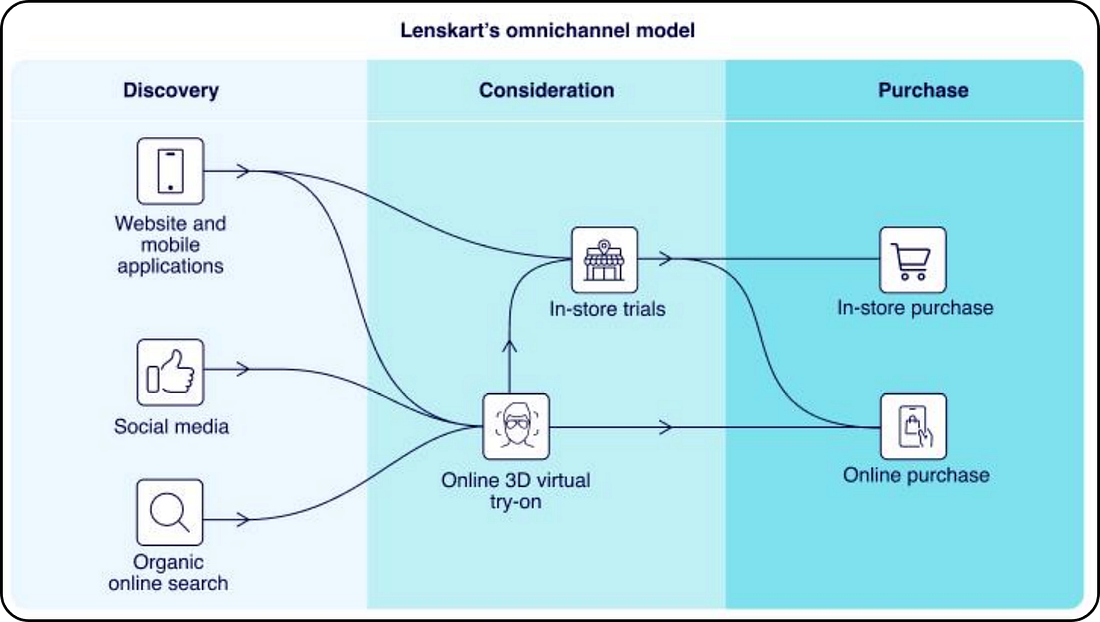
Its operational model is fully vertically integrated: from conceptualising and designing eyewear to manufacturing and direct sales, everything happens in-house. On top of this, Lenskart has adopted an omnichannel approach, blending online reach with offline presence to create a layered customer acquisition strategy.

This combination of control over the value chain and hybrid sales channels gives it a unique edge in an industry where most competitors depend on third-party manufacturing or retail partners.Source: Lenskart Solutions Limited, DRHP

Lenskart’s integration gives it a serious cost edge. No middlemen inflating prices 2.5–4x, and massive scale from selling 27.2 million eyewear units in FY25.

Source: Lenskart Solutions Limited, DRHP

Scaling Smart: How Lenskart Turns Size into Strategy

By operating at a massive scale, Lenskart is able to source frames and lenses at 35–50% lower costs than most competitors. This cost advantage, supported by manufacturing control through facilities in Gurugram, Bhiwadi, and soon Telangana — plus overseas plants in Singapore, the UAE, and a joint venture in China — allows the company to sustain gross margins close to 70%.

But the benefit goes far beyond profitability. Full control over both design and manufacturing gives Lenskart agility — crucial in a category where eyewear doubles as both a medical necessity and a fashion accessory. This integration allows the company to respond quickly to emerging trends, keep products fresh, and strengthen customer stickiness. Evidence? Over 98% of customers make repeat purchases within two years, many also renewing their paid Gold Membership.

The company’s measured approach to international growth further reinforces its base. Instead of rushing into new markets, founder and CEO Peyush Bansal prefers to acquire established players that align with Lenskart’s strengths in India. Today, it operates 656 stores abroad, each chosen with precision, aiming for premium margins in targeted geographies while keeping India as the anchor. This strategy draws parallels to global eyewear leader EssilorLuxottica, which holds about 20% global market share.

A First for Public Investors

With an estimated 25–40% share of India’s organised eyewear market, Lenskart sits well ahead of its nearest competitor. Yet, until now, retail investors had no way to directly invest in a dedicated eyewear business in India. Titan Eye exists, but it’s housed under Titan Company Ltd, where jewellery is the mainstay. Lenskart’s listing changes that — offering a pure-play opportunity in a growing, underpenetrated sector.

The company is financially robust, generating operating cash flow at 1.27 times EBITDA. For investors, this IPO is not just another debut — it represents the market’s first chance to own a focused leader in Indian eyewear.

The Growth Lens

India’s eyewear market is projected to be worth ₹78,800 crore in 2025, expanding at an annual rate of 13.5%. Prescription lenses make up 70% of the market, and demand is set to climb sharply as 62% of the population is expected to suffer from vision issues within five years.

Initially, Lenskart expanded through a franchise-led, asset-light model, which appealed because of quick payback — often just over 10 months, and even shorter in smaller cities. However, strained franchise relationships have prompted a strategic pivot. Now, the company is focusing on expanding company-owned outlets, enhanced with AI-driven tools and remote eye-testing capabilities to boost accessibility.

Final Frame

From a startup to a retail powerhouse with global aspirations, Lenskart has become one of India’s most compelling consumer stories. Whether it evolves into the “EssilorLuxottica of the East” will unfold in time — but for investors, the opportunity to buy into India’s eyewear growth story after 17 years of waiting is finally here.


:


The image added is for representation purposes only

Foreign Investors Pull Back: FPIs Exit Indian Equities for Second Straight Week

Lenskart’s IPO: A Clear Vision for India’s Eyewear Future

Foreign Investors Pull Back: FPIs Exit Indian Equities for Second Straight Week

Foreign Investors Pull Back: FPIs Exit Indian Equities for Second Straight Week

FPIs Sell Indian Stocks for 2nd Week in a Row — Should You Worry?
Foreign investors have once again turned net sellers of Indian equities, pulling out funds for the second consecutive week. While the headline numbers look concerning, domestic sentiment has so far remained resilient. But the persistent outflows highlight a shift in global risk appetite and signal that caution may be warranted in the months ahead.

Who Are FPIs and Why Do They Matter?
Foreign Portfolio Investors (FPIs) are large overseas funds, global banks, pension funds, and asset managers who buy and sell shares in Indian stock markets. They are not long-term strategic owners like Foreign Direct Investors (FDI) but move money based on short- to medium-term opportunities.
Their influence is substantial — FPIs own between 16% and 20% of India’s total market capitalisation. Their buying brings foreign currency inflows, strengthens the rupee, and lifts market valuations. Conversely, sustained selling can weigh on both the stock market and the currency.
When FPIs act in unison, their trades can swing daily market volumes and even drive sentiment for retail and domestic institutional investors (DIIs).

What’s Happening in August 2025?
In the week ending August 1, FPIs sold ₹17,000 crore worth of Indian equities. This marks the second straight week of outflows, adding to what is already a heavy year for foreign selling.
So far in 2025, over ₹1.03 lakh crore ($11.8 billion) has left Indian equities. More telling is the fact that FPIs sold stocks on all five trading days last week — a sign of consistent bearish positioning rather than a one-off rebalancing.

Why Are FPIs Selling? Four Key Drivers
1. Trump’s 50% Tariff on Indian Exports
The reimposition of Donald Trump’s protectionist trade stance has unsettled global markets. His 50% tariff on Indian exports comes alongside criticism of India’s continued purchase of Russian oil.
For sectors like textiles, auto components, gems and jewellery, and chemicals — which rely heavily on US demand — such tariffs threaten revenue and margins. For FPIs, this adds a new layer of trade friction risk, reducing the near-term appeal of Indian exporters.
2. US Dollar Strength & Higher US Interest Rates
The US dollar index is holding firm around the 100 mark, while US Treasury yields remain elevated. For global investors, this means they can park funds in US bonds with attractive, risk-free returns.
At the same time, the Indian rupee has weakened to ₹87.20 per dollar, making Indian assets less lucrative. Even if stock prices rise in rupee terms, currency conversion erodes dollar returns. This currency headwind is often a decisive factor for foreign fund managers.
3. India’s Expensive Stock Market
Indian equities have commanded premium valuations for several years. While this reflects strong domestic growth and corporate earnings, it also makes the market more vulnerable during periods of uncertainty.
The Nifty 50’s price-to-earnings (P/E) ratio is above its historical average and well above the multiples in other emerging markets like China or Brazil. In a global rotation, relatively cheaper markets tend to attract more capital, drawing money away from India.
4. Mixed Corporate Earnings and Growth Concerns
The Q1 FY26 earnings season has delivered a mixed bag. While some sectors like banking and telecom have performed well, industrial growth has slowed, and several companies have reported results below market expectations. This earnings uncertainty reduces the case for aggressive FPI buying.

Sector-Wise FPI Trends
The latest data shows a sharp divergence in sectoral flows:
Heavy Selling:
• IT: ₹30,600 crore (hit by slower US client spending and delayed technology budgets)
• FMCG: ₹18,178 crore (margin pressures, weak rural demand recovery)
• Power: ₹15,422 crore (profit booking after strong rallies)
• Auto & Auto Components: ₹11,308 crore (tariff fears, slowing exports)
Selective Buying:
• Telecom: ₹26,685 crore (5G rollout, digital infrastructure growth)
• Financial Services: ₹13,717 crore (credit growth, strong balance sheets)
The selling appears concentrated in sectors exposed to export risk and those trading at rich valuations, while flows remain positive in domestic demand-driven industries.

Looking Back: How Does 2025 Compare?
The current year’s trend is in sharp contrast to recent history:
• 2023: FPIs invested ₹1.71 lakh crore, fuelled by a global risk-on environment and India’s growth narrative.
• 2024: Net inflow of just ₹427 crore — effectively flat, as cautious sentiment emerged late in the year.
• 2025: Big reversal, with more than ₹1 lakh crore leaving in just seven months.
The swings underline how quickly FPI sentiment can change based on geopolitical developments, US monetary policy, and risk-adjusted returns in other markets.

Is the Market Panicking? Not Yet.
Interestingly, despite heavy foreign selling, Indian benchmark indices have not seen a proportionate collapse. This resilience is largely due to strong domestic institutional inflows and steady retail investor participation through SIPs (Systematic Investment Plans).
DIIs have been net buyers in recent weeks, offsetting much of the FPI outflow impact. The deepening domestic investor base is providing a cushion against external shocks — a major difference from earlier decades when FPI withdrawals could spark sharp corrections.

Conclusion: The Road Ahead
While India’s long-term growth story remains intact, near-term volatility cannot be ruled out. Key factors to watch include:
• US policy direction on trade and interest rates
• Movement of the rupee against the dollar
• Domestic corporate earnings in Q2 FY26
• Global commodity prices, especially oil
If US interest rates remain high and the dollar stays strong, FPI flows into India may remain subdued. However, a policy shift or softer economic data from the US could prompt a reversal — history shows that FPI sentiment can flip quickly.
For now, the market is absorbing the selling without major panic. But if outflows persist for several more weeks, the pressure on both equities and the rupee could intensify, testing the market’s resilience.


:


The image added is for representation purposes only

NSDL Shares Jump 16%, Push Value Past ₹25,000 Crore

Foreign Investors Pull Back: FPIs Exit Indian Equities for Second Straight Week

NSDL Shares Jump 16%, Push Value Past ₹25,000 Crore

NSDL Shares Jump 16%, Push Value Past ₹25,000 Crore

The sharp post-listing momentum in National Securities Depository Limited (NSDL) shares showed no signs of cooling on August 8, as the stock surged nearly 16 percent, extending gains for a third straight session. Since debuting on the bourses earlier this week, the depository giant has delivered a stellar 48 percent jump in value, pushing its market capitalization past the ₹25,000 crore milestone.

With Thursday’s rally, the stock is now trading more than 62 percent above its issue price, underscoring the strong appetite among investors despite a moderate listing premium on debut.

Three-Day Market Debut Performance

With a listing price of ₹880 per share on the BSE, NSDL became public on the secondary market on August 6. This was 10% higher than the IPO price of ₹800 per share. While the listing gain came in slightly lower than the expectations indicated by the grey market—where the stock commanded an estimated 16 percent premium before debut—the company’s subsequent performance has far exceeded early forecasts.

Over the course of the first three sessions, the stock has consistently advanced, adding a cumulative 48 percent from its listing price and propelling its market value into the top tier of newly listed companies.

Analysts Endorse Long-Term Potential

Experts in the market attribute the ongoing buying demand to NSDL’s strong operational model and established market leadership. Mehta Equities Ltd.’s Senior Vice President (Research Analyst), Prashanth Tapse, claims that the company stands out in the domestic depository market due to its supremacy in value-based transactions and institutional account holdings.

“NSDL continues to lead in value-centric transaction volumes and institutional accounts, supported by a trusted industry reputation and advanced technological infrastructure,” Tapse said. “Operating alongside CDSL in what is effectively a near-duopoly, the company benefits from significant entry barriers for potential competitors.”

He added that for investors who were allotted shares in the IPO, maintaining a long-term position is advisable. Those who did not receive allotment may consider entering the stock on any post-listing correction.

Strong Fundamentals, but Caution Advised

Echoing a similar view, Saurabh Jain, Head of Equity Research (Fundamentals) at SMC Global Securities, highlighted NSDL’s dominant market share, broad service reach, and diversified asset coverage as pillars for sustained expansion. He emphasized that macroeconomic growth trends and supportive regulatory policies further bolster the company’s growth trajectory.

However, Jain also noted potential vulnerabilities. “While the long-term story remains compelling, the company’s revenue is sensitive to fluctuations in transaction volumes. Changing investor participation trends, evolving regulatory norms, and the growing complexity of cybersecurity threats are key risk factors to watch,” he said.

Valuation Context and Industry Comparison

From a valuation perspective, NSDL is currently trading at a price-to-earnings (P/E) ratio of around 77, which is notably higher than its peer, Central Depository Services (India) Ltd. (CDSL), whose P/E stands near 66. The premium suggests investors are factoring in NSDL’s leadership position and anticipated earnings growth.

The Indian depository segment is characterized by its high entry barriers, owing to the technological investment, regulatory clearances, and market trust required to operate. As one of only two depositories in the country, NSDL’s near-monopoly position provides it with a competitive edge. Alongside CDSL, it plays a critical role in maintaining and safeguarding securities ownership records, enabling smooth settlement of trades, and supporting the rapidly growing domestic capital markets.

IPO and Listing Journey

NSDL’s IPO was closely tracked by both institutional and retail investors, given the company’s pivotal role in India’s financial market infrastructure. While the moderate listing premium initially suggested a tempered debut, the subsequent rally reflects strong secondary market demand, likely fueled by institutional interest and the scarcity value of such a unique business model.

The grey market premium ahead of the listing—about 16 percent over the IPO price—indicated healthy, though not exuberant, investor sentiment. But with the stock now trading significantly higher than both its IPO and listing price, the market has clearly reassessed its valuation metrics in light of the company’s fundamentals and growth prospects.

Strategic Positioning for the Future

NSDL’s operations span a wide range of services, from dematerialization of securities to facilitating capital market transactions, settlement services, and investor account maintenance. Its stronghold in institutional accounts and value-based transactions underpins a stable revenue base, while technological capabilities allow it to maintain high service efficiency and data security standards.

Looking ahead, market participants expect the company to benefit from India’s expanding equity culture, increasing retail participation, and the continued digitization of financial services. Regulatory pushes towards transparency and formalization of capital market activities are also likely to enhance the role of depositories in the broader financial ecosystem.

Investor Outlook

For now, the market mood towards NSDL remains decisively bullish. The combination of limited competition, strong industry positioning, and macroeconomic tailwinds is drawing in long-term investors, even at elevated valuations.

Still, the company’s high P/E ratio and sensitivity to transaction-based revenue streams suggest that disciplined entry points could be prudent, particularly for investors who missed out on the IPO. Experts agree that while NSDL is well-placed for structural growth, short-term volatility could arise from market-wide corrections, regulatory changes, or shifts in investor trading patterns.

Conclusion

In just three days since listing, NSDL has transformed from a moderately received IPO debutant into one of the standout performers of 2025’s primary market season. With a market capitalization now exceeding ₹25,000 crore and shares trading over 60 percent above the issue price, the company has firmly captured investor attention.

As India’s largest depository by value, NSDL’s strong fundamentals and strategic market position make it a compelling long-term play. However, as with all high-growth, high-valuation stocks, a measured approach to accumulation—especially for new entrants—remains the prudent course.


:


The image added is for representation purposes only
Gabriel India Stock Rockets Nearly 80% in 13 Sessions: What’s Driving This Surge?