Menu

Business

Jindal Steel & Power Q1 FY26: Profits Surge on Operational Gains and Strategic Growth

Jindal Steel & Power Q1 FY26: Profits Surge on Operational Gains and Strategic Growth

Jindal Steel & Power Q1 FY26: Profits Surge on Operational Gains and Strategic Growth

Jindal Steel & Power Posts Strong Profit Growth Despite Modest Revenue Drop

Introduction: JSPL’s Q1 FY26 Performance Highlights a Strategic Rebound
In the first quarter of financial year 2026, Jindal Steel & Power recorded a marked recovery in profitability, swinging from a loss in the previous quarter to significant gains. The company exhibited resilience amid challenging sectoral dynamics, including fluctuating demand and cost pressures, driven largely by its focus on efficiency, product quality, and capacity growth.

Financial Overview: Profit Growth Amid Revenue Softening
• Net Profit: ₹1,496 crore, up 36% quarter-on-quarter, affirming a recovery from the prior quarter’s loss of ₹339 crore.
• Revenue: ₹12,294 crore, down 6.7% from ₹13,183 crore in Q4 FY25, reflecting cautious demand conditions.
• EBITDA: Increased 32% YoY to ₹3,006 crore.
• EBITDA Margin: Rose sharply to 24.4%, up from 17.2% in the previous quarter.
• Net Debt: Rose to ₹14,400 crore, with the net debt to EBITDA ratio edging up to 1.49x.
The profitability jump was driven by better operational execution, higher contribution from value-added steel products, and margin improvements despite a modest drop in topline revenue.

Production and Sales Dynamics: Volume Steady Amid Sales Dip
Jindal Steel’s steel production remained steady around 2.09 million tonnes (MT), a marginal 1% decline over the previous quarter. However, sales volumes saw a more notable 10% reduction to 1.9 MT, attributed primarily to post-seasonal inventory replenishment effects.
Key operational highlights included:
• Exports: Export share doubled to 7%, reflecting the company’s growing reach in international markets.
• Value-Added Products: Value-Added Products accounted for a record 72% of total sales, highlighting JSPL’s strategic focus on higher-margin steel products.

Strategic Expansion: Capacity and Product Enhancement Projects
JSPL is advancing multiple critical expansions and modernization projects aimed at boosting production quality and scale:
• Angul Blast Furnace: Set to commission India’s second-largest blast furnace shortly, which will enhance production efficiency and capacity significantly.
• Continuous Galvanizing Line: The 0.2 MTPA line (CGL-1) recently commissioned broadens JSPL’s portfolio in value-added steel.
• Other Projects: These include a 0.5 MTPA Hot Rolled Skin Pass Mill, a 3.6 MTPA twin strand slab caster, and a 1,710 TPD oxygen plant — all designed to improve operational scale and product quality.
• Technological Enhancements: Deployment of Cut to Length (CTL) and Hot Rolled (HR) Slitter lines furthers manufacturing precision.
These investments position JSPL for sustainable growth and competitiveness as demand for advanced steel products rises globally.

Market Response and Analyst Perspectives
The market responded positively to JSPL’s earnings announcement, with shares rising shortly after results were declared. Analysts noted:
• The profit rebound, improved margins, and expanded exports underline JSPL’s operational turnaround.
• While the revenue dip is a concern, the shift towards value-added products and capacity enhancements is pro-growth.
• Some caution remains about elevated debt levels, though manageable given improved earnings.
Consensus recommendations remain mostly positive, with many brokers endorsing a “buy” or “hold” rating based on growth prospects.

Challenges and Outlook
Despite strong performance, JSPL faces ongoing challenges:
• Demand Volatility: Softening sales volume reflects broader cyclical demand fluctuations in steel markets.
• Cost Pressures: Raw material, energy, and logistics costs remain elevated, requiring operational discipline.
• Debt Management: Rising net debt necessitates careful financial strategy to maintain leverage ratios within comfort zones.
Looking ahead, JSPL remains focused on:
• Leveraging expanded capacity from Angul to meet growing domestic and export demand.
• Further increasing value-added product sales to drive margin enhancement.
• Continuing investments aimed at sustainable operations and environmental compliance.

Conclusion: JSPL’s Q1 FY26 Performance Reinforces Growth Trajectory
Jindal Steel & Power’s Q1 FY26 results illustrate a company recovering robustly from previous setbacks, with profit growth driven by operational efficiencies and strategic capital projects. While revenue softened slightly, limiting near-term growth, the company’s expanded capacity, rising export share, and shift toward high-value steel products bode well for sustainable profitability.
As JSPL commissions major facilities and pursues product innovation, it appears well-positioned to capture future opportunities in India’s steel sector and beyond.


:


The image added is for representation purposes only

MRF Q1 FY26: Revenue Up, Profits Down on Margin Pressures


MRF Q1 FY26: Revenue Up, Profits Down on Margin Pressures

MRF Q1 FY26: Revenue Up, Profits Down on Margin Pressures

MRF Q1 FY26: Revenue Up, Profits Down on Margin Pressures

Tire Industry Leader Navigates Rising Costs and Market Challenges While Expanding Sales

Introduction: MRF Faces Margin Headwinds Despite Topline Strength
MRF, India’s largest tire manufacturer, kicked off fiscal year 2026 with mixed financial results. While revenue from operations grew robustly by nearly 7% year-on-year, the company’s net profit declined by over 12%, impacted mainly by a contraction in profit margins due to higher input prices and increased expenses. The results underscore the challenges posed by a volatile commodity environment even as demand showed resilience.

Financial Overview: Profit Drops Even as Revenue Climbs
For the quarter ended June 30, 2025 (Q1 FY26), MRF’s consolidated financial highlights stood as follows:
• Revenue from operations: stood at ₹7,676 crore, up 6.7% from ₹7,196 crore in Q1 FY25.
• Consolidated net profit (PAT): ₹500 crore, down 12.36% year-on-year from ₹571 crore.
• Profit before tax (PBT): ₹1,198 crore, marginally lower than the previous year’s ₹1,244 crore.
• EBITDA: ₹1,034 crore, with trailing EBITDA margin compressed by over 200 basis points to approximately 13.7% (from 16.1% YoY).
• Gross margin: Declined by 300 basis points to 34.3%, reflecting higher raw material costs which rose around 6%.
The margin squeeze was primarily driven by inflationary pressures on key inputs like natural rubber, synthetic rubber, and crude derivatives, coupled with higher energy and logistical expenses.

Operational Highlights and Segment Performance
MRF’s revenue growth reflected firm demand across various product segments and geographies:
• Volume Growth: Increased tire sales volume amid steady aftermarket demand and growth in original equipment manufacturer (OEM) segment.
• Segment Mix: Focus on premium and value-added tire segments helped sustain top-line expansion.
• Other Income: While operational profitability declined, other income streams provided some cushioning to overall earnings.
• Cost Controls: Management emphasized ongoing initiatives to optimize operational efficiencies and reduce waste.
The company continues to actively monitor supply chain dynamics and cost trends to manage margin pressures effectively.

Strategic Initiatives: Capacity Expansion and Technological Upgrades
Despite short-term profitability challenges, MRF is progressing with several strategic projects to bolster future growth:
• Capacity Expansion: Investments to increase production capabilities at existing plants to meet rising demand domestically and internationally.
• Technology Upgrades: Modernization efforts are underway to enhance product quality, reduce manufacturing costs, and improve energy efficiency.
• Product Innovation: Focus on developing new tire technologies suited for electric vehicles and performance segments.
• Market Penetration: Efforts to grow export markets and expand distribution reach, especially in skill-intensive and premium segments.
Such initiatives position MRF to capitalize on long-term industry trends including rising automotive production and the transition to greener mobility solutions.

Market Reaction and Analyst Views
Following the Q1 results announcement, MRF’s stock exhibited modest correction reflective of profit decline concerns:
• Investor Sentiment: The mixed results caused caution among investors, although the revenue growth offered some optimism.
• Analyst Take: Brokerage houses highlighted the margin compression as a near-term challenge but acknowledged resilient demand and growth initiatives.
• Outlook: Analysts recommend close attention to raw material price trends and operational execution in upcoming quarters as key determinants of recovery.
MRF remains among the most watched players in India’s tyre industry given its market leadership and strategic importance.

Challenges and Outlook
MRF’s Q1 FY26 performance highlighted ongoing challenges:
• Volatile Input Costs: Raw material inflation continues to strain profit margins.
• Rising Expenses: Energy, logistics, and other operational costs are adding to margin pressures.
• Competitive Landscape: Intense competition in domestic and export markets necessitates continued focus on innovation and cost efficiency.
• Economic Uncertainties: Macro factors such as inflation, currency volatility, and supply chain disruptions remain risks.
Looking forward, MRF aims to:
• Sustain revenue growth through enhanced capacity and new product launches.
• Enhance and sustain margins through cost-control initiatives and operational efficiency.
• Utilize technological innovations to meet growing demand in emerging markets, including electric vehicles.

Conclusion: MRF Balances Growth and Margin Pressure in Challenging Cycle
MRF’s Q1 FY26 results reveal a company growing its sales volumes in a difficult cost environment but facing pressure on profitability. The revenue increase reflects strong market traction, yet margin compression underscores the need for continued efficiency gains. With planned capacity expansions and technology investments, MRF is committed to navigating these challenges and sustaining its leadership in the tire sector over the long term.

.


:


The image added is for representation purposes only

ONGC Q1 FY26 Results: Profit Growth Amid Revenue Decline

Tilaknagar Industries Q1 FY26: Profit Soars Amid Expansion Plans

Tilaknagar Industries Q1 FY26: Profit Soars Amid Expansion Plans

Tilaknagar Industries Q1 FY26: Profit Soars Amid Expansion Plans

Leading Indian IMFL maker posts record quarterly earnings with robust volume growth and strategic acquisition plans

Financial Performance Overview: Q1 FY26
Tilaknagar Industries Limited, renowned for its flagship brand Mansion House Brandy and as one of India’s leading IMFL producers, unveiled an outstanding set of results for the quarter ended June 30, 2025. Consolidated revenue rose 30.6% year-on-year to about ₹409 crore, up from ₹313 crore in the corresponding quarter last year.
Adjusting for a government subsidy of ₹38.6 crore, revenue still recorded a robust growth of 20.5%, underscoring genuine demand strength. Volume growth was equally impressive, with shipments rising 26.5% YoY to 32.1 lakh cases, marking the highest quarterly volume since FY15 and highlighting the company’s successful penetration and market expansion efforts.

Profitability Rockets on Margin Expansion
Tilaknagar Industries’ profitability mirrored its top-line momentum. EBITDA soared by an exceptional 88%, touching ₹94.5 crore compared to ₹50.2 crore a year ago. EBITDA margin jumped to 23.1%, an increase of 700 basis points from 16% in Q1 FY25.
Even excluding the subsidy impact, EBITDA grew by 25%, affirming that operational efficiency and cost discipline were significant contributors to this margin enhancement.
Net profit after tax (excluding exceptional items) more than doubled, increasing by 120.8% to ₹88.5 crore, up from ₹40.1 crore in Q1 FY25. This translated into a healthy earnings per share (EPS) of about ₹4.54 per share, more than doubling from the previous year.

Volume Growth and Market Share Gains
Chairman and Managing Director Amit Dahanukar highlighted the quarter as a period of strong, consistent growth that outpaced the industry for Tilaknagar Industries. The company experienced notable market share improvement in each key region, particularly in the southern states, where demand grew robustly.
Volume gains were central to the company’s growth story, driven by widening distribution, stronger brand acceptance, and strategic pricing moves. Though price reductions in specific states like Andhra Pradesh impacted topline growth compared to volume, the overall contribution remained positive, supporting sustainable growth.

Strategic Expansion and Acquisition Moves
Tilaknagar is actively investing in capacity expansion and inorganic growth to strengthen its competitive positioning. The Board approved a ₹25 crore capital expenditure to boost bottling capacity at its Prag Distillery subsidiary in Andhra Pradesh, scaling from 6 lakh to 36 lakh cases annually.
Meanwhile, Tilaknagar is advancing its transformative acquisition of Pernod Ricard India’s Imperial Blue brand business, valued at about €413 million (₹4,150 crore).
This acquisition, currently pending Competition Commission of India (CCI) approval expected by the end of 2025, will add substantial premium brand value, broaden the product portfolio, and significantly bolster market presence.

Investor Response and Market Outlook
Following the results announcement, Tilaknagar Industries’ shares rose as much as 6% intraday and ended the session close to ₹500. The market welcomed the combination of strong financial performance and bold growth initiatives.
Management’s forward-looking statements indicate confidence in maintaining volume momentum and scaling profitability by capturing rising consumer preference trends and expanding into high-growth states.

Challenges and Considerations
While the results are encouraging, the company faces typical sector challenges including:
• Regulatory environment and state-specific policy shifts impacting liquor pricing and availability.
• Competition from both established players and emerging regional brands.
• Execution risks related to integration and synergies from the Imperial Blue acquisition.
• Sustaining margin expansion amid input cost fluctuations.
However, Tilaknagar’s strong cash position, demonstrated by net cash of ₹163 crore as of June 2025, and strategic investments position it well to navigate these hurdles.

Conclusion: Positioned for Industry Leadership
Tilaknagar Industries’ Q1 FY26 performance highlights the success of its growth strategy, driven by higher volumes, stronger margins, and bold expansion initiatives.
The company’s robust financial footing enables it to pursue acquisition-driven growth, capitalizing on emerging premiumization trends in the Indian IMFL sector.
If the anticipated acquisition gains regulatory clearance and volume momentum continues, Tilaknagar could cement its leadership among India’s top liquor producers. The blend of organic and inorganic strategies bodes well for sustained value creation and competitive differentiation.


:


The image added is for representation purposes only

Shalimar Paints Q1 FY26: Losses Reduce as Revenue Climbs

Alpex Solar Q1 FY26: Stellar Growth Pushes Company to New Peaks

Alpex Solar Q1 FY26: Stellar Growth Pushes Company to New Peaks

Alpex Solar Q1 FY26: Stellar Growth Pushes Company to New Peaks

Demonstrating explosive revenue and profit surges, Alpex Solar shows robust operational momentum backed by strategic capacity expansions

Financial Performance Overview: Q1 FY26
Alpex Solar Ltd posted outstanding unaudited consolidated results for the quarter ended June 30, 2025, showcasing a remarkable turnaround fueled by soaring sales and improved operational efficiency.
The company reported revenue from operations of approximately ₹380.32 crore, marking an astonishing 395.7% increase compared to the same quarter last year.
Profitability indicators were even more impressive. PAT jumped an astounding 3,888% to ₹42.29 crore from ₹1.06 crore in Q1 FY25, while EBITDA soared 1,058% to ₹57.39 crore, reflecting significant margin gains and effective cost management.
The company’s basic earnings per share (EPS) ballooned to ₹17.28, a substantial leap from ₹0.43 share a year earlier, signaling enhanced shareholder value and operational leverage.

Capacity Expansion Driving Growth Ambitions
Aligned with its aggressive growth strategy, Alpex Solar’s Board approved a capital expenditure of ₹110 crore to establish a new 1.2 GW solar module manufacturing facility at Kosi Kotwan, Uttar Pradesh. This plant is slated for commissioning in FY 2026-27 and will augment the company’s total manufacturing capacity to 3.6 GW—including 1.2 GW currently operational at Unit I, and an upcoming 1.2 GW facility expected in FY 2025-26.
This expansion plan reflects Alpex Solar’s commitment to meeting rising global and domestic demand for high-efficiency solar modules. The new capacity is expected to enhance input cost efficiencies, support larger scale production, and enable the company to compete effectively with international manufacturers.

Market Dynamics and Operational Strength
Alpex Solar’s explosive growth comes amid a favorable policy environment promoting renewable energy adoption in India and worldwide. Government incentives, ambitious solar capacity installation targets, and increasing corporate sustainability commitments fuel demand for solar technologies.
The company reported strong sales growth led by both volume expansion and improved selling prices, underscoring effective market penetration and premium product positioning. Higher realizations per unit reflect advancements in module efficiency and the ability to command better pricing in competitive markets.
Additionally, stringent cost management and supply chain optimization helped Alpex significantly expand operating margins despite global supply chain pressures.

Sustainability and Future Outlook
Alpex Solar’s operational success dovetails with the global energy transition toward clean sources. With an industry-leading capacity scale-up strategy and technological investments, the company expects to sustain revenue and profit growth in coming years.
Leadership reaffirmed the focus on:
• Accelerating capacity augmentation to capitalize on growing demand.
• Advancing module efficiency and innovation to maintain competitiveness.
• Expanding export markets alongside domestic sales.
• Leveraging government schemes and policy frameworks supporting renewable energy.
The strong order book and ongoing product development pipeline position Alpex Solar as a key player in the Indian and global solar sectors.

Conclusion: Onward and Upward in Solar Energy Leadership
Alpex Solar’s standout Q1 FY26 results mark its emergence as a leading force in solar manufacturing.
The near quadrupling of revenues and nearly 40-fold profit growth underscore operational excellence and market acceptance.
With aggressive capacity expansions and a strategic vision aligned with global clean energy trends, Alpex is poised for sustained momentum. The company’s trajectory points toward expanding market share, enhanced technological capabilities, and deepened stakeholder value.
While solar markets remain dynamic, Alpex Solar’s robust execution and financial strength provide a solid foundation to capitalize on the surging demand for sustainable energy solutions in India and worldwide.


:


The image added is for representation purposes only

INOX Green Share Price Surges After Sealing 182 MW Wind O&M Deal

Bosch Ltd Q2 FY26: Auto Demand Boosts Sales, Profit Inches Up Despite Higher Costs

Remsons Industries Q1 FY26: Consolidated Growth Powers Ahead

Remsons Industries Q1 FY26: Consolidated Growth Powers Ahead

Financial Highlights: Q1 FY26
Remsons Industries, a leading Indian supplier of automotive cables and components, announced robust consolidated financial results for the quarter ended June 2025. Consolidated revenue surged to approximately ₹99.6 crore, reflecting a sharp 30% rise over the previous year. PAT surged 73% year-on-year, coming in at around ₹3.6 crore for the quarter.
Earnings per share also followed this growth trajectory, underscoring the company’s operational discipline and strong demand from global and domestic customers. At the same time, consolidated operating margins crept higher: EBITDA rose by 63% year-on-year, and a healthy 11% operating margin was reported.
However, standalone results painted a contrasting picture. Standalone revenues fell by nearly 8%, and standalone net profit slipped 11% year-on-year, primarily due to persistent softness in domestic core markets.

Strategic Expansion and New Ventures
Remsons’ management has pushed strongly into diversification and external partnerships to insulate it from domestic cyclical weaknesses. The company launched a new subsidiary, Remsons Edge Technologies Private Limited, and completed a significant (35.86%) minority acquisition in Astro Motors Private Limited. These bold moves aim to reinforce Remsons’ portfolio, boost R&D, and add new revenue streams, particularly through electric vehicle and high-value product segments.
Further, Remsons has aggressively broadened its product range and is steadily progressing on its stated ambition to venture into the railway and defense sectors—two markets with promising long-term potential.

Operational Excellence and International Push
Despite muted domestic auto sector trends during the quarter, Remsons outperformed its industry peers thanks to a blend of operational efficiencies, robust export growth, and a shift towards high-value, customized products. Management cited export realization and premium orders as critical drivers for consolidated revenue growth, particularly as overseas markets offered better pricing and stability.
Export growth and diversification not only cushioned against local market headwinds but also helped drive up profitability, as evidenced by the year-on-year expansion in margins.

Chairman’s Perspective: Confidence Amid Uncertainties
Chairman and Managing Director Krishna Kejriwal said the company’s strong results highlight its flexible and resilient business model.
He stressed that, even in a sluggish auto market, the company achieved remarkable results by advancing high-value segments, enhancing operational efficiency, and maintaining a firm focus on creating value for shareholders.
The company aims to reach a revenue milestone of ₹900–1,000 crore by FY29 as part of its medium-term goals. Management’s ongoing commitment to invest in technology, people, and process innovation remains central to this goal.

Challenges: Standalone Softness and Sectoral Risks
The main blemish in Q1’s performance was the dip in standalone revenue and profit. While the reasons include subdued demand from core Indian OEM clients and heightened competition, the company appears confident that its strategic pivots—such as moving further up the value chain and increasing export reliance—will help mitigate these headwinds moving forward.
Remsons also faces the broader cyclical risks affecting the auto sector, including input cost volatility, currency fluctuations, and changing regulatory norms. Nonetheless, its diversified base and strong cash position provide some insulation.

Conclusion: On Track for Ambitious Growth, with Cautious Optimism
Remsons Industries’ Q1 FY26 performance demonstrates the effectiveness of its transformation efforts and diversification into both product lines and geographies. Robust consolidated growth and margin expansion speak to improving competitiveness and operational focus. While soft spots remain in certain business verticals, particularly domestically, the company’s trajectory remains positive.
Management’s medium-term outlook is upbeat, grounded in investments in innovation, new business verticals, and continued global expansion. If Remsons sustains its strategic discipline, further market share gains and profitability improvements are likely.


:


The image added is for representation purposes only

Reliance Retail Writes Off $200 Million Dunzo Investment — A Wake-Up Call for Quick-Commerce in India

Reliance Retail Writes Off $200 Million Dunzo Investment — A Wake-Up Call for Quick-Commerce in India

Reliance Retail Writes Off $200 Million Dunzo Investment — A Wake-Up Call for Quick-Commerce in India

Reliance Retail Writes Off $200 Million Dunzo Investment — A Wake-Up Call for Quick-Commerce in India

From Quick Growth to Quick Collapse
Dunzo’s journey began with a bold vision — delivering groceries, meals, medicines, and everyday essentials in hours, if not minutes. Backed by deep-pocketed investors and growing urban demand, the startup once stood out in India’s crowded delivery market.
By early 2022, Reliance Retail led a $240 million funding round for Dunzo, securing roughly a 26% stake. At its peak, Dunzo’s valuation touched around $770 million, positioning it among India’s most anticipated tech growth stories.
But the optimism didn’t last. Intense competition from Swiggy’s Instamart, Zepto, and Zomato-owned Blinkit drove up customer acquisition costs and operational expenses. Dunzo struggled to match rivals’ aggressive discounts, expansive delivery networks, and better-capitalized war chests.

Financial and Operational Troubles
The company’s financial health deteriorated rapidly:
• Losses tripled from ₹464 crore in FY22 to ₹1,801 crore in FY23.
• Burn rate remained unsustainably high, driven by quick-commerce warehousing, delivery fleet expenses, and marketing.
• Multiple city exits reduced the operational footprint to just parts of Bengaluru.
• Salaries for employees were delayed multiple times, eroding morale.
• Leadership turnover — including the eventual departure of co-founder and CEO Kabeer Biswas to Flipkart — left the company without steady strategic direction.
The collapse in performance sent Dunzo’s valuation into free fall. Reports suggest that potential buyers are now discussing acquisition prices between $25–30 million — barely 3–4% of its peak value.

Why Reliance Pulled the Plug
For Reliance Retail, the write-off was an acknowledgment of reality. With no credible turnaround plan, shrinking market presence, and mounting liabilities, the likelihood of recovering its investment was virtually zero. Continuing to hold the asset on the balance sheet would only misrepresent its financial position.
The decision also reflects a broader shift in Reliance’s priorities. Rather than propping up a failing independent brand, the company may focus on integrating last-mile delivery into its own ecosystem — particularly through JioMart and other in-house ventures — where it can exercise greater control over strategy, capital, and execution.

Lessons for the Quick-Commerce Industry
Dunzo’s decline underlines the fragility of the quick-commerce model, especially in markets where customers are price-sensitive and competition is funded by deep investor pockets. Speed alone is not enough; operational efficiency, sustainable margins, and differentiated services are critical.
Some key takeaways:
1. Cash alone doesn’t buy sustainability — Without a clear path to profitability, even large funding rounds can vanish quickly in the face of market competition.
2. Over-expansion can kill agility — Scaling too fast without stabilizing core markets can stretch operations thin.
3. Loyalty trumps convenience when margins are thin — Rivals that create sticky ecosystems (e.g., subscription programs, integrated payment systems) retain customers more effectively.

Possible Pathways for a Dunzo Revival
While the company’s future remains uncertain, there are still strategic options that could be considered — whether by a new owner or in a restructured form:
1. Niche Market Focus
Instead of competing head-to-head with larger players on mass-market groceries, Dunzo could focus on premium, specialized segments — such as gourmet foods, medicine delivery, or high-value B2B local logistics.
2. Partnership-Driven Model
Collaborating with small and mid-sized retailers who cannot build their own delivery networks could allow Dunzo to become a logistics enabler rather than a direct consumer brand.
3. Cost-First Restructuring
Streamlining warehousing, moving to a lighter inventory model, and focusing on hyperlocal clustering can dramatically reduce cash burn.
4. Tech as a Differentiator
Using AI-driven inventory management, predictive delivery routes, and real-time demand forecasting could help optimize both costs and delivery times.

The Broader Industry Outlook
Quick-commerce in India is not dead — in fact, demand continues to rise in urban centers. But the market is consolidating, with only a handful of well-funded players likely to survive. For smaller or struggling brands, survival will depend on adaptability, partnerships, and a willingness to abandon the “everything for everyone” approach.
Reliance’s decision to cut its losses with Dunzo is both a cautionary tale and a strategic recalibration. It’s a reminder that in fast-moving consumer tech, even marquee names can falter if the fundamentals don’t hold.
The next chapter for Dunzo — whether as a niche service, a logistics partner, or a relic of India’s startup boom — will depend on how decisively and creatively its next stewards act.


:


The image added is for representation purposes only

Lenskart’s IPO: A Clear Vision for India’s Eyewear Future

India’s year-end IPO blitz: risks, rewards and what to watchIndia’s year-end IPO blitz: risks, rewards and what to watch

Lenskart’s IPO: A Clear Vision for India’s Eyewear Future

Lenskart’s IPO: A Clear Vision for India’s Eyewear Future

Lenskart Steps Toward Public Listing

India’s stock market is about to get its first pure-play eyewear listing, with Lenskart gearing up for an IPO that could raise ₹2,150 crore. The offering is designed to give early backers an exit route while channelling fresh funds into expanding company-owned stores.

It’s a milestone headline — but does the business story live up to the excitement? Let’s unpack what’s happening, explore Lenskart’s market position, and see what the road ahead might look like.

A Long-Awaited Move

After recording its first-ever profitable year, Lenskart has filed its Draft Red Herring Prospectus (DRHP) in preparation for going public. The company plans to issue fresh equity worth ₹2,150 crore.

Since its inception, Lenskart has gone through 19 funding rounds, raising about $1.08 billion in total. This IPO will allow some of its earliest investors to cash out while injecting new capital into the business. A significant share of these funds is earmarked for CoCo (company-owned, company-operated) outlets, along with expansion via acquisitions.

What makes this debut particularly noteworthy is that nearly 40% of Lenskart’s revenue already comes from international markets. Unlike most Indian consumer brands focused on domestic dominance, Lenskart is openly chasing global market share — a move that even veteran banker Uday Kotak questioned earlier this year.

The Lenskart Playbook

At first glance, many think of Lenskart as a tech-first brand thanks to its app and website. In reality, the company’s DNA is rooted in physical retail — in India and abroad.

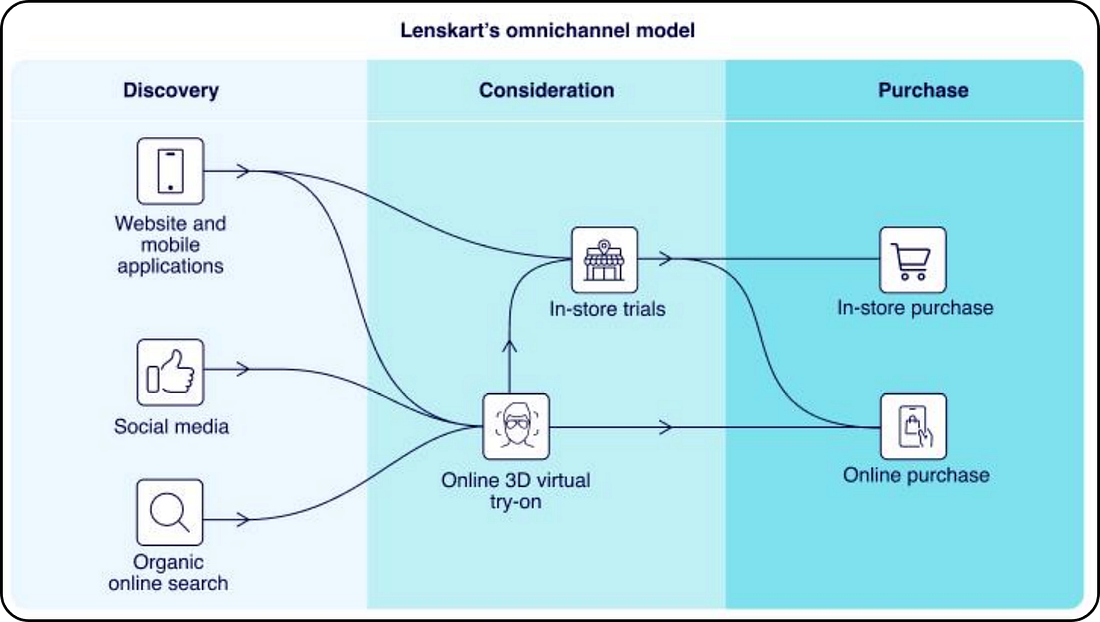
Its operational model is fully vertically integrated: from conceptualising and designing eyewear to manufacturing and direct sales, everything happens in-house. On top of this, Lenskart has adopted an omnichannel approach, blending online reach with offline presence to create a layered customer acquisition strategy.

This combination of control over the value chain and hybrid sales channels gives it a unique edge in an industry where most competitors depend on third-party manufacturing or retail partners.Source: Lenskart Solutions Limited, DRHP

Lenskart’s integration gives it a serious cost edge. No middlemen inflating prices 2.5–4x, and massive scale from selling 27.2 million eyewear units in FY25.

Source: Lenskart Solutions Limited, DRHP

Scaling Smart: How Lenskart Turns Size into Strategy

By operating at a massive scale, Lenskart is able to source frames and lenses at 35–50% lower costs than most competitors. This cost advantage, supported by manufacturing control through facilities in Gurugram, Bhiwadi, and soon Telangana — plus overseas plants in Singapore, the UAE, and a joint venture in China — allows the company to sustain gross margins close to 70%.

But the benefit goes far beyond profitability. Full control over both design and manufacturing gives Lenskart agility — crucial in a category where eyewear doubles as both a medical necessity and a fashion accessory. This integration allows the company to respond quickly to emerging trends, keep products fresh, and strengthen customer stickiness. Evidence? Over 98% of customers make repeat purchases within two years, many also renewing their paid Gold Membership.

The company’s measured approach to international growth further reinforces its base. Instead of rushing into new markets, founder and CEO Peyush Bansal prefers to acquire established players that align with Lenskart’s strengths in India. Today, it operates 656 stores abroad, each chosen with precision, aiming for premium margins in targeted geographies while keeping India as the anchor. This strategy draws parallels to global eyewear leader EssilorLuxottica, which holds about 20% global market share.

A First for Public Investors

With an estimated 25–40% share of India’s organised eyewear market, Lenskart sits well ahead of its nearest competitor. Yet, until now, retail investors had no way to directly invest in a dedicated eyewear business in India. Titan Eye exists, but it’s housed under Titan Company Ltd, where jewellery is the mainstay. Lenskart’s listing changes that — offering a pure-play opportunity in a growing, underpenetrated sector.

The company is financially robust, generating operating cash flow at 1.27 times EBITDA. For investors, this IPO is not just another debut — it represents the market’s first chance to own a focused leader in Indian eyewear.

The Growth Lens

India’s eyewear market is projected to be worth ₹78,800 crore in 2025, expanding at an annual rate of 13.5%. Prescription lenses make up 70% of the market, and demand is set to climb sharply as 62% of the population is expected to suffer from vision issues within five years.

Initially, Lenskart expanded through a franchise-led, asset-light model, which appealed because of quick payback — often just over 10 months, and even shorter in smaller cities. However, strained franchise relationships have prompted a strategic pivot. Now, the company is focusing on expanding company-owned outlets, enhanced with AI-driven tools and remote eye-testing capabilities to boost accessibility.

Final Frame

From a startup to a retail powerhouse with global aspirations, Lenskart has become one of India’s most compelling consumer stories. Whether it evolves into the “EssilorLuxottica of the East” will unfold in time — but for investors, the opportunity to buy into India’s eyewear growth story after 17 years of waiting is finally here.


:


The image added is for representation purposes only

Foreign Investors Pull Back: FPIs Exit Indian Equities for Second Straight Week

Shree Renuka Sugars Q2 FY26: Revenue Holds Up Seasonally, But Loss Widened Sharply as Costs Bite

Tata Elxsi Q1 FY26 Net Profit Drops 22% Amid Global Headwinds

Tata Elxsi Q1 FY26 Net Profit Drops 22% Amid Global Headwinds

A challenging macroeconomic environment dampened Tata Elxsi’s financial performance in the first quarter of FY26, with notable declines in both profit and revenue.
Tata Elxsi, a leading provider of design and technology services across industries such as automotive, healthcare, and media, reported a steep decline in its earnings for the April–June 2025 quarter. The company’s consolidated profit after tax (PAT) dropped by 22% year-on-year to ₹144 crore from ₹184 crore in the corresponding quarter of the previous fiscal. The fall in earnings reflects the broader slowdown in global demand, particularly in the transportation and media sectors, which form a significant portion of Tata Elxsi’s business portfolio.

Revenue Falls as Client Spending Weakens

Tata Elxsi also saw its operating revenue slip by 3.7% to ₹892 crore compared to ₹926 crore in Q1 FY25. The fall in revenue is attributed to reduced discretionary spending by global clients, especially in the automotive and media & entertainment domains. With inflationary pressures, tight capital allocation, and prolonged decision-making cycles at the client end, new business opportunities have taken longer to convert, thereby slowing the overall topline growth.
Sequentially, however, the company managed to maintain a relatively flat performance, with some recovery seen in its transportation vertical, which registered a 3.7% quarter-on-quarter growth in volume terms.

EBITDA and Margins Under Pressure

Operating performance also took a hit during the quarter. Earnings before interest, taxes, depreciation, and amortization (EBITDA) fell approximately 26% year-on-year to ₹187 crore. EBITDA margins contracted to 20.9% from 27.2% in the year-ago period. The drop in margin was due to higher operational expenses, salary adjustments, and a weaker revenue base.
Profit before tax (PBT) came in at ₹196 crore, marking a 22.2% decline from the ₹252 crore reported in Q1 FY25. The margin pressure suggests that Tata Elxsi is facing difficulty balancing growth with cost optimization in the current environment.

Transportation Segment Shows Resilience

Despite overall weakness, the company’s largest business segment — transportation — displayed signs of recovery. This vertical, which contributes more than 50% of the firm’s revenue, recorded steady growth on a sequential basis. Although it remained flat on a constant currency basis, management expressed optimism that the transportation business would see an uptick in the second half of the year as delayed client projects resume.
On the other hand, segments like media & communications and healthcare remained sluggish due to lower tech investments by clients and ongoing budget constraints. The company continues to diversify its offerings to reduce dependency on any single vertical.

Strategic Deal Wins Highlight Growth Potential

Amid the earnings pressure, Tata Elxsi secured several strategic deals that could boost its performance in the coming quarters. Notably, the company signed a multi-million-dollar agreement with a prominent U.S.-based technology firm to support AI-driven product design and digital engineering. Additionally, it has forged a partnership in the medical devices space focused on cardiovascular testing and regulatory compliance.
These deal wins underline Tata Elxsi’s strength in innovation-led offerings and its ability to adapt to emerging industry needs such as AI, automation, and next-gen product development.

Management’s Outlook: Cautious Optimism

CEO and Managing Director Manoj Raghavan acknowledged the difficult quarter, citing macroeconomic headwinds, delayed client decisions, and weaker R&D spending. However, he emphasized that the company remains committed to long-term growth and is confident about improving performance in the second half of FY26.
He also noted that the current pipeline of opportunities remains strong, with clients increasingly engaging in discussions around digital transformation, autonomous systems, and cloud integration — all of which align with Tata Elxsi’s core strengths.

Stock Market Reaction Reflects Investor Concern

Tata Elxsi’s stock reacted negatively to the Q1 results. The shares dropped nearly 7% intraday following the earnings announcement, reflecting investor concerns about the decline in profit and revenue. The stock touched a low of around ₹5,660 during trading and ended the day among the top losers on the Nifty Midcap index.
Despite short-term volatility, analysts believe that Tata Elxsi remains fundamentally strong but may face continued margin pressure unless macro conditions improve or deal conversions accelerate. Some brokerages have issued a “sell” or “underperform” rating, citing valuation concerns and earnings risks in the near term.

Future Growth Hinges on H2 Recovery

Tata Elxsi’s performance in the first quarter underscores the challenges posed by a volatile global economic climate. However, with new client wins, a growing focus on high-value segments like AI and medical devices, and signs of revival in the transportation domain, the company is laying the groundwork for a rebound.
The second half of FY26 will be crucial in determining whether Tata Elxsi can convert its strong pipeline into tangible revenue growth and margin expansion. If macro conditions stabilize and clients resume their digital investment cycles, the firm may well return to a positive trajectory.


:


The image added is for representation purposes only

IREDA Bonds Gain Tax Benefits to Promote Green Energy

Revolut Eyes $65 B Funding Round to Fuel U.S. Expansion

Revolut Eyes $65 B Funding Round to Fuel U.S. Expansion

Revolut Eyes $65 B Funding Round to Fuel U.S. Expansion

London-based fintech titan Revolut is in active discussions to raise around $1 billion in fresh capital under a $65 billion valuation, aiming to supercharge its ambitious expansion in the United States and beyond.

Turning Heads with a New Valuation

Revolut’s management is engaged in talks to mix new share issuance and existing stock sales to bring in about $1 billion. Industry observers expect the round will anchor around a “blended” $65 billion valuation—higher for new issuances, slightly lower for secondary-market transactions FinTech Weekly – Home Page+10AOL.com+10Devdiscourse+10.
This comes after Revolut’s valuation stood at $45 billion in 2024, following a secondary share sale that attracted fresh and existing investors FinTech Weekly – Home Page+7AOL.com+7MarketScreener Canada+7. The significant valuation bump signals strong investor appetite for fintech disruptors.

Big-Name Investors in the Mix
U.S. investment firm Greenoaks is reportedly leading the charge on this funding round, with Mubadala—Abu Dhabi’s sovereign wealth vehicle—also exploring a $100 million addition to its stake Benchmark Beat+6AInvest+6AInvest+6. Both parties have previously shown confidence in Revolut.
Sources indicate Greenoaks is poised to helm the round, though terms are still being negotiated Wikipedia+12AOL.com+12Finance Magnates+12.

Explaining the “Blended” Valuation
The $65 billion figure is not meant to be a straightforward valuation—it’s a blend:
• New shares are priced more optimistically.
• Secondary sales among current shareholders are pegged lower.
This results in a blended headline number FinTech Weekly – Home Page+4Axios+4Financial Times+4Tech Startups+4AInvest+4AOL.com+4MarketScreener Canada.
Such valuation mark-ups are common in fintech funding—consider Stripe, which hit a high-water mark before retreating during its public debut .

Financial Strength & Growth Momentum
Revolut has demonstrated impressive financial firepower:
• In 2023, it reported £1.1 billion in pretax profit, overturning a previous loss Wikipedia+12AInvest+12Benchmark Beat+12MarketScreener Canada+1AOL.com+1.
• That momentum continued into 2024 with net profit doubling to £790 million and revenue roughly £3.1 billion Wikipedia.
• User numbers are climbing fast—it now serves over 60 million customers globally, up from around 50 million in late 2024 AInvest+2Wikipedia+2Finance Magnates+2.
These figures explain why fresh capital is incoming at a heftier valuation.

Expansion Strategy: U.S. Focus, Global Outlook
The fresh funding will help accelerate Revolut’s penetration in the U.S.—a core focus area—as evidenced by partnerships with Sutton Bank and Cross River Bank to support its American banking ambitions Benchmark BeatTechCrunch+10Tech Funding News+10Axios+10.
Additionally, Revolut is diversifying its offer with:
• Expansion into digital mortgages and business lending
• Launching an AI-driven financial assistant, branded ATMs in Spain, and global investment features like ETFs with BlackRock/Vanguard MarketScreener Canada+2AInvest+2Tech Funding News+2.
The offer is steadily evolving into a full-fledged “financial super app.”

CEO Incentives & Exit Strategy Options
Revolut CEO Nik Storonsky stands to benefit substantially from a successful round or future IPO—reportedly topping out at 10 % equity if the company reaches a $150 billion valuation Financial Times+3AInvest+3Benchmark Beat+3.
The firm is also reportedly laying groundwork for an IPO, with a preference for New York based on its global reach AInvest+5AInvest+5Tech Funding News+5. Although a listing isn’t imminent, market dynamics could influence timing.

Market Context & Valuation Trends
This round highlights wider trends in fintech investing. Revolut’s leap from a $45 billion to $65 billion evaluation in under a year reflects growing confidence, especially given its strong profit performance. However, caution is warranted: other fintechs like Stripe have seen valuations contract post-funding Finance Magnates.
Still, with $4 billion in annual revenue and half a billion in profit, Revolut distinguishes itself among peers—attractive to investors on both primary and secondary fronts Tech Funding News.

Regulatory & Competitive Landscape
Revolut faces regulatory scrutiny—which it has addressed with UK and EU banking licenses granted in 2024—and is improving its compliance systems Tech Funding News. Its capability to expand U.S. services hinges on navigating licensing and maintaining robust regulatory relations.
Furthermore, the fintech space is highly competitive: legacy banks and rivals like Wise and Monzo are vying for market share. Revolut’s growth, scale, and product breadth represent its main defense.

What Comes Next?
Expect the following developments:
1. Deal Finalization: Greenoaks and Mubadala are key players; terms and timing remain fluid.
2. U.S. Rollout: Accelerated launch of U.S. banking and lending services.
3. Product Rollout: New mortgages, business credit products, AI financial tools, banking app enhancements.
4. IPO Planning: Potential NYSE listing, timed with market conditions and internal milestones.
5. Valuation Watch: Investors and analysts will track how performance and market sentiment affect valuation.

Final Take: Bold Move with Smart Groundwork
Revolut’s move to raise funding at a lofty valuation underscores its strong financial footing and ambitious global expansion plans. While some may question fintech exuberance, the company’s profitability and growth-backed metrics set it apart. If regulatory and market conditions remain favorable, this funding round could be a powerful springboard for its next phase.


:


The image added is for representation purposes only

IREDA Bonds Gain Tax Benefits to Promote Green Energy

Arkade Developers: High-Margin, Debt-Free Growth in Mumbai Realty

Arkade Developers: High-Margin, Debt-Free Growth in Mumbai Realty

Arkade Developers: High-Margin, Debt-Free Growth in Mumbai Realty

Arkade Developers Ltd. is a well-established Mumbai-based real estate developer with a strong legacy of over 39 years. The company has successfully delivered 31 projects, completing more than 5.5 million sq. ft. of development and housing over 5,500 families. Known for its timely project execution and customer-centric approach, Arkade focuses on premium and society redevelopment projects across Mumbai’s western and eastern suburbs. As of March 31, 2025, the promoter and promoter group, led by Mr. Amit Mangilal Jain, hold a 71.09% stake in the company. It is listed on both NSE (Symbol: ARKADE) and BSE (Code: 544261). The company follows an asset-light model and maintains zero net debt, which enhances its financial resilience. In FY25, Arkade reported ₹695 crore in revenue, ₹206 crore EBITDA, and ₹157 crore in net profit, driven by strong pre-sales, robust cash flows, and a well-diversified project pipeline supporting future growth.


Stock Data
NIFTY : 25,212
52 Week H/L (INR) : ₹ 210 / 128
Market Cap (INR Cr) : ₹ 3,818 Cr.
Book Value : ₹ 47.6
Outstanding Shares (Cr.) : 18.6
NSE Code : ARKADE
BSE Code : 544261
CMP : ₹ 206

Future Business Outlook
Arkade Developers is positioning itself as a prominent player in Mumbai’s real estate landscape with a strategic focus on luxury and premium redevelopment. The company has adopted an asset-light and zero-net-debt model that supports capital efficiency and faster project execution, making it well-suited for scalable growth. Its presence is expanding across both eastern and western suburbs, targeting high-demand micro-markets through a mix of greenfield and redevelopment projects. Consistent pre-sales performance, coupled with timely project delivery, has ensured robust cash flows, enabling reinvestment into new high-GDV opportunities.
Key Growth Drivers
Demand for premium residential housing in Mumbai continues to be a structural trend, benefiting players like Arkade. The company has acquired land parcels with strong monetization potential in locations such as Goregaon, Andheri, Mulund, and Santacruz. Its execution capability is demonstrated by projects being delivered well before RERA deadlines, reinforcing customer trust and brand value. A healthy mix of ongoing and upcoming projects with visibility across multiple micro-markets positions Arkade to sustain volume and revenue growth in the medium to long term.
Project Pipeline
Arkade currently has 9 ongoing projects (~2 Mn sq. ft.) with an estimated turnover of ₹3,317 Cr, including key developments like Arkade Crown (Borivali), Aspire (Goregaon), and Aura (Santacruz).

The company also has 10 upcoming projects (~2.22 Mn sq. ft.) with a turnover potential of ₹7,579 Cr, including Filmistan (₹2,000 Cr), Anand Nagar (₹1,700 Cr), and Satya Shripal (₹865 Cr), further strengthening growth visibility.
Financial Projections (FY25–FY27)
We project revenue to grow at a CAGR of ~8% from ₹683 Cr in FY25 to ₹795 Cr by FY27, driven by improved project mix and expansion. Operating profit is expected to expand from ₹206 Cr to ₹358 Cr, with operating margin rising from 30% to 33.7%, supported by cost controls and scale benefits. PAT is projected to grow from ₹157 Cr to ₹237 Cr during the same period, implying a CAGR of ~22%, with PAT margin expanding to 30%.
Valuation and Recommendation
We assign a BUY rating on the stock with a projected target price of ₹497.73, based on 39x FY27E EPS of ₹12.76. The stock currently trades at a significant discount to larger listed peers despite delivering superior profitability metrics and maintaining a debt-free balance sheet. Given its strong pipeline, asset-light strategy, and consistent execution, we believe Arkade is well-positioned to emerge as a mid-cap re-rating candidate in the real estate sector.

Absolute Returns (%)

3 Months : 22.3%
6 Months : 27.1 %

VALUATION OUTLOOK

Undervalued vs Peers:
Arkade trades at EV/EBITDA of 17.4x and P/E of 24.3x, both below the peer average of 45.6x EV/EBITDA and 82.7x P/E, indicating strong rerating potential. Discounted EV/Sales Multiple:
Arkade’s EV/Sales of 5.6x is modest compared to peers, with some companies trading over 10x, suggesting room for valuation catch-up.

Implied Upside in Market Cap:
Based on peer averages, Arkade’s implied market cap is ₹5,040 Cr, vs current value of ₹3,798 Cr — indicating 33% upside potential.

Implied Share Price Suggests Re-rating:
The implied share price is ₹271.4, compared to the current ₹205.56, suggesting the stock is undervalued at present levels.

Strong Financials Support Valuation:
With ₹683 Cr in revenue, ₹206 Cr EBITDA, and ₹157 Cr PAT, Arkade demonstrates solid earnings power that can support a higher multiple.

Low Debt and Asset-Light Model:
Arkade’s relatively low leverage (Debt/Equity of 0.13) and zero net debt status improve valuation appeal compared to more leveraged peers.

Metric

FY24 Cr. FY25 Cr. YoY Growth

(%)

Revenue from Operations 636 695 9.27%
Gross Profit 206 264 28.2%
Gross Profit Margin 32.40% 38.6% +620 bps
EBITDA 167 206 23.4%
EBITDA Margin 26.3% 29.6% +330 bps
Profit Before Tax (PBT) 211.4 266.8 26.18%
Profit After Tax (PAT) 123 157 27.6%
PAT Margin 19.3% 22.9%  
ROCE% 45% 31%  
ROE 38.08% 17.76%  
Debt to Equity 0.22 0.13  


1. Business Model & Key Differentiators

Arkade Developers Ltd. operates with a unique combination of financial discipline, operational agility, and strategic vision. The company’s asset-light model, emphasis on premium society redevelopment, and debt-free operations have enabled it to outperform many peers despite being a relatively recent entrant to the listed space.

1. Asset-Light Strategy & Zero Net Debt

Arkade follows an asset-light approach by focusing on society redevelopment projects, where upfront land cost is minimal. This enhances return on capital and keeps the balance sheet flexible.

Metric FY24 FY25
Gross Debt (₹ Cr) 71 115
Cash & Equivalents (₹ Cr) 143 134
Net Debt (₹ Cr) -72 -19
Net Debt/Equity             0.00 0.13
Model Type Redevelopment-focused Redevelopment + Greenfield

Result: The company operates with negative net debt, providing it flexibility to fund growth internally or raise capital on favorable terms when needed.

2. In-House Project Management = Faster Turnaround

Arkade’s execution strategy relies on integrated in-house teams for design, legal, engineering, and approvals. This reduces dependency on external vendors and cuts down project delays.

Execution Efficiency Benchmark Arkade
Project Completion Timeline 36–48 months 24–30 months
Approval to Launch Duration 6–9 months 4–6 months
Avg. Cost Overrun Industry: ~10% <5%

 Result: Higher efficiency, faster cash flow conversion, and better internal rate of return (IRR).

3. Early RERA Completion Record

Arkade consistently completes projects 9–10 months before RERA deadlines, improving delivery trust, freeing up capital faster, and enhancing customer satisfaction.

Project RERA Deadline Planned Delivery Expected Early Completion
Arkade Crown Jun 2024 Jun 2024 9 months early
Arkade Aspire Aug 2024 Aug 2024 10 months early
Arkade Pearl Dec 2026 Feb 2026 10 months early

 Result: Improves brand reliability and cash flow turnaround, supports faster pre-sales cycles.

4. High-IRR Development Model

Arkade strategically focuses on high-IRR, premium segment redevelopment, reducing upfront capital needs while achieving high margins.

IRR Benchmarks Industry Avg. Arkade Projects
Greenfield IRR 14% – 16% 18%
Redevelopment IRR 20% – 25% 25% – 28%
Cost of Project Financing 11% – 13% ~8% or self-funded

 Result: Maximizes return per rupee invested and enhances EPS over time.

5. Strong CSR & ESG Integration

Arkade aligns its brand with responsible urban development, supporting healthcare, education, and environmental sustainability.

Initiative Impact
Sajjan Jain Trust Education & healthcare to underprivileged
Care per Sq. Ft. (Tata Hospital) Cancer treatment donations for every sq. ft. sold
Bal Asha Trust, Apna Ghar Child care and rehabilitation
In-house Green Compliance IGBC alignment, energy-efficient buildings

 Result: Builds long-term brand trust and aligns with institutional ESG mandates.

2. Detailed Analysis: Ongoing Projects of Arkade Developers Ltd.

Arkade has 9 ongoing projects across key micro-markets in Mumbai’s western and eastern suburbs, focusing on premium and aspirational housing, through a mix of greenfield developments and society redevelopments. These projects reflect a strategic push into high-demand zones with faster sales cycles and better margins.

Project Name Location Category Development Type Plot Size (Sq. M) Saleable Area (Sq. Ft.) Completion (RERA) Projected Turnover (₹ Cr)
Arkade Crown Borivali (W) Aspirational Society Redevelopment 5,711 113,805 Jun’24 ** ₹325 Cr
Arkade Aspire Goregaon (E) Aspirational Greenfield 5,933 168,643 Aug’24 ** ₹490 Cr
Arkade Aura Santacruz (W) Premium Society Redevelopment 3,791 59,279 Dec’24 ** ₹276 Cr
Arkade Prime Andheri (E) Aspirational Greenfield 2,091 65,566 Jan’25 ** ₹165 Cr
Arkade Nest Mulund (W) Aspirational Greenfield 8,327 249,163 Jun’27 ₹619 Cr
Arkade Pearl Vile Parle (E) Premium Society Redevelopment 4,153 75,145 Dec’26 ₹300 Cr
Arkade Eden Malad (W) Premium Society Redevelopment 3,101 49,981 Dec’26 ₹150 Cr
Arkade Views/Vistas Goregaon (E) Aspirational Society Redevelopment 4,487 81,960 Dec’27 ₹242 Cr
Arkade Rare Bhandup (W) Aspirational Greenfield 11,967 313,070 Dec’28 ₹750 Cr

 Strategic Importance

  • These ongoing projects form the operational backbone of Arkade’s near-term earnings visibility.
  • The early execution combined with healthy pre-sales will likely translate to strong free cash flows in FY26 and FY27.
  • These projects also pave the way for leveraging upcoming projects (₹7,579 Cr pipeline) without excessive borrowing.

 3Detailed Analysis: Upcoming Projects of Arkade Developers

Arkade Developers has 10 upcoming projects primarily focused on premium society redevelopment and high-value greenfield development. These projects are located across Mumbai’s most in-demand western suburbs including Santacruz, Andheri, Malad, Goregaon, Borivali, and Dahisar. The combined saleable area exceeds 2.22 million sq. ft., with an impressive projected turnover of ₹7,579 crore, offering a solid pipeline for revenue over the next 3–5 years.

Project Name Location Category Development Type Plot Size (Sq. M) Saleable Area (Sq. Ft.) Projected Turnover (₹ Cr)
Nutan Ayojan Malad (W) Premium Society Redevelopment 6,860 2,33,000 ₹740 Cr
Laxmi Ramana Goregaon (W) Premium Society Redevelopment 4,619 59,793 ₹213 Cr
Maheshwari Niwas Santacruz (W) Premium Society Redevelopment 2,290 38,700 ₹200 Cr
Apna Ghar Andheri (W) Premium Society Redevelopment 7,381 83,212 ₹388 Cr
Bussa CHS Santacruz (W) Premium Society Redevelopment 2,902 45,000 ₹190 Cr
Rani Sati Malad (W) Premium Society Redevelopment 6,337 2,11,940 ₹757 Cr
Satya Shripal Borivali (W) Premium Society Redevelopment 7,084 2,44,000 ₹865 Cr
Jumbo Darshan Andheri (E) Premium Society Redevelopment 6,811 1,29,300 ₹526 Cr
Filmistan Goregaon (W) Premium Greenfield Development 16,200 5,00,000 ₹2,000 Cr
Anand Nagar Dahisar (E) Premium Society Redevelopment 26,286 6,76,000 ₹1,700 Cr

4. Quarterly Performance (Q4 FY25)

Metric Q4 FY24 Q4 FY25 YoY Growth (%)
Revenue from Operations ₹123.0 ₹134.0 +8.9%
Gross Profit ₹41 ₹60 +46.30%
EBITDA ₹27 ₹45.0 +66.7%
EBITDA Margin (%) 22.00% 33.6%  
Net Profit (PAT) ₹20 ₹33.0 +65%
PAT Margin (%) 16.30% 24.6%  
Pre-Sales Value ₹196.0 ₹217.0 +10.71%
Collections ₹176.0 ₹238.0 +35.23%
Carpet Area Sold (sq. ft. in ’000) 64 70 +9.38%

 Q4 FY25 Performance Summary (YoY Comparison)

  • Revenue from Operations rose 8.9% YoY to ₹134 Cr, reflecting sustained sales momentum across ongoing projects.
  • Gross Profit increased by 46.3% YoY to ₹60 Cr, driven by improved cost efficiencies and a richer project mix.
  • EBITDA witnessed robust growth of 66.7% YoY, reaching ₹45 Cr, underscoring strong operational leverage.
  • EBITDA Margin expanded sharply by 1,160 bps, improving from 22.0% to 33.6%, indicating enhanced project-level profitability.
  • Net Profit (PAT) grew 65% YoY to ₹33 Cr, with PAT margin improving from 16.3% to 24.6%, aided by higher margins and stable overheads.
  • Pre-sales Value stood at ₹217 Cr, up 10.71% YoY, backed by healthy booking traction.
  • Collections rose significantly by 35.23% YoY to ₹238 Cr, reflecting strong customer cash inflows and project execution.
  • Carpet Area Sold increased 9.38% YoY to 70,000 sq. ft., indicating continued demand and sales conversion strength.

5. Financial Highlights (P&L Statement)

Particulars 2021 2022 2023 2024 2025 YoY Growth (Mar-24 to Mar-25)
Revenue (₹ Cr) 106 225 220 635 683 7.56%
Expenses (₹ Cr) 80 170 160 467 477 2.14%
Operating Profit 26 54 60 168 206 22.61%
OPM % 24% 24% 27% 26% 30%  
Other Income 5 15 8 2 12  
Interest (₹ Cr) 1 4 1 3 2 -33.33%
Depreciation (₹ Cr) 0 0 0 1 5  
Profit Before Tax 29 66 67 165 211 27.88%
Tax % 25% 22% 24% 26% 26%  
Net Profit (₹ Cr) 22 51 51 123 157 27.64%

 Key Financial Highlights – FY25 (YoY Comparison)

  • Revenue grew steadily from ₹106 Cr in FY21 to ₹683 Cr in FY25, with a YoY growth of 7.56%, reflecting consistent business expansion.
  • Operating Expenses remained tightly managed, increasing by just 2.14% YoY in FY25, despite a higher scale of project execution.
  • Operating Profit rose by 22.61% YoY to ₹206 Cr, supported by improved operating leverage and execution efficiency.
  • Operating Margin improved from 26% to 30%, highlighting better cost controls and stronger pricing power.
  • Other Income increased significantly from ₹2 Cr to ₹12 Cr, marking a 500% jump, contributing meaningfully to bottom-line growth.
  • Interest Expense declined by 33.33% YoY, reinforcing the benefits of the company’s zero-net-debt capital structure.
  • Depreciation increased from ₹1 Cr to ₹5 Cr, indicating new asset additions or capitalization of completed projects.
  • Profit Before Tax (PBT) stood at ₹211 Cr, up 27.88% YoY, showcasing strong operational profitability.
  • Net Profit (PAT) grew by 27.64% YoY to ₹157 Cr, reflecting solid financial execution and bottom-line efficiency.
  • Tax Rate remained stable at 26%, in line with prior periods.

6. Financial Highlights
Balance Sheet Statement

Particulars 2021 2022 2023 2024 2025 YoY Growth (Mar-24 to Mar-25)
Equity Capital (₹ Cr) 2 2 2 152 186 22.37%
Reserves (₹ Cr) 97 148 198 171 698 308.77%
Borrowings (₹ Cr) 14 64 149 71 115 61.97%
Other Liabilities (₹ Cr) 237 156 206 180 252 40.00%
Total Liabilities (₹ Cr) 350 370 555 575 1,251 117.57%
Fixed Assets (₹ Cr) 0 2 2 14 19 35.71%
CWIP (₹ Cr) 0 0 0 0 0 No Change
Investments (₹ Cr) 114 40 17 18 138 666.67%
Other Assets (₹ Cr) 236 329 536 543 1,093 101.22%
Total Assets (₹ Cr) 350 370 555 575 1,251 117.57%

 Key Balance Sheet Highlights – FY25

  • Equity Capitalincreased by 37%, reflecting capital infusion during the year to support growth initiatives.
  • Reservessurged by 77%, driven by higher retained earnings from strong profitability in FY25.
  • Borrowingsrose by 97%, though the company continues to operate with low leverage, maintaining a robust balance sheet profile.
  • Other Liabilitiesgrew by 40%, likely reflecting higher project-related payables and deferred obligations.
  • Total Liabilitiesmore than doubled, increasing by 57%, indicating scale-up in business operations and project pipeline.
  • Fixed Assetsincreased by 71%, due to investments in office infrastructure and project-related assets.
  • Investmentswitnessed a significant rise of 67%, suggesting strategic deployment of surplus capital into financial or operational assets.
  • Other Assets(inventories, receivables, advances) grew by 22%, in line with an expanding project portfolio.
  • Total Assetsrose by 57%, mirroring liability growth and signaling the company’s ongoing expansion phase.
  • Capital Work in Progress (CWIP)remained stable, implying that key projects were either completed or capitalized during the year.

7. Financial Highlights (Cash Flow Summary)

Particulars Mar-21 Mar-22 Mar-23 Mar-24 Mar-25
Cash from Operating Activity + 144 -125 -99 102 -218
Cash from Investing Activity + -98 76 29 -12 -229
Cash from Financing Activity + -49 46 84 -83 445
Net Cash Flow -3 -2 14 7 -1

 Key Cash Flow Highlights (FY21–FY25)

  • FY21:
    Generated a strong operating cash inflow of ₹144 Cr, driven by robust core business performance.

    High investing outflow of ₹98 Cr suggests capital allocation toward project development or asset purchases.
    Net cash flow stood at ₹-3 Cr, reflecting near cash-neutral operations despite significant investments.
  • FY22:
    Reported negative operating cash flow of ₹-125 Cr, likely due to inventory buildup or working capital blockage.
    Investing inflow of ₹76 Cr may have resulted from asset divestment or reduced capex.
    Net cash flow of ₹-2 Cr, indicating minor cash burn.
  • FY23:
    Operating cash flow remained negative at ₹-99 Cr, as project investments continued.

    Moderate investing inflow of ₹29 Cr combined with positive financing inflow of ₹84 Cr, reflecting successful fundraising.
    Net cash flow turned positive at ₹+14 Cr, marking a temporary recovery.
  • FY24:
    Achieved a strong operating inflow of ₹102 Cr, supported by improved collections and profitability.

    Financing outflow of ₹83 Cr suggests debt repayment or dividend distribution.
    Net cash flow of ₹+7 Cr indicates growing financial stability.
  • FY25:
    Experienced a significant operating outflow of ₹-218 Cr, likely due to aggressive project execution or advance payments.

    Investing outflow of ₹229 Cr reflects substantial capital deployment into land or redevelopment rights.
    Financing inflow of ₹445 Cr points to major fundraising activity through equity or debt.
    Despite large cash movements, net cash flow stood at ₹-1 Cr, showcasing prudent capital management and balance sheet resilience.

8.  Ratio Analysis

Leverage Ratios 2021 2022 2023 2024 2025
Debt/Equity 0.14 0.43 0.74 0 0.13
Debt/Assets 0.04 0.17 0.27 0 0
Debt/EBITDA 0.54 1.19 2.48 0 1
Efficiency Ratios
Receivable Days 44 9 6 5 19
Receivable Turnover 8.3 40.56 60.83 73 19.21
Profitability Ratios
EBITDA 26 54 60 168 206
EBITDA Margin 24% 24% 27% 26% 30%
Gross Profit 98.58 319.5 422.4 622.3 266.37
EBIT 0 0 0 169 213
EBIT Margin 0.00% 0.00% 0.00% 27.00% 31.00%
Net Profit Margin 20.75% 22.67% 23.18% 19.37% 22.99%
EPS 105.95 252.35 253.9 8.08 8.45
Capital Allocation Ratios
ROCE   41% 24% 45% 31%
EBIT Margin 0.00% 0.00% 0.00% 27.00% 31.00%
Sales/Cap Employed 94% 105% 63% 161% 68%
NOPAT 0 0 0 125.06 157.62
Capital Employed 101 204 331 369 865
Valuation Ratios
Price/Earnings 17.88
Price/Book 3.18
EV/EBITDA 13.63

 Key Ratio Analysis – FY25

1. Leverage Ratios

Debt-to-Equity dropped from 0.74 in FY23 to 0.13 in FY25, reflecting the company’s transition to a zero net-debt position in FY24, significantly strengthening the balance sheet.

Debt/EBITDA improved to 1.0x, indicating comfortable leverage relative to earnings.

2. Efficiency Ratios

Receivable Days increased to 19 (vs. 5 in FY24), suggesting a mild delay in collections cycle.

Receivable Turnover decreased to 19.2x, though still reflects healthy receivables management.

3. Profitability Ratios

EBITDA Margin expanded to 30%, supported by better project margins and cost efficiencies.

Net Profit Margin stood at 22.99%, underlining strong bottom-line performance.

EPS remained steady at ₹8.45, despite equity dilution following the public listing.

4. Capital Allocation Metrics

ROCE moderated to 31% (vs. 45% in FY24), due to a higher capital base post fundraising.

Sales/Capital Employed at 68% reflects efficient use of capital in driving topline growth.

NOPAT rose to ₹157.6 Cr, in line with higher operating profits and tax-adjusted performance.

5. Valuation Ratios

P/E Ratio stood at 17.88x, and EV/EBITDA at 13.63x, indicating potential undervaluation compared to peers.

P/B Ratio at 3.18x remains reasonable, supported by robust ROE and strong growth visibility.

9. Financial Projections

Particulars FY2025 (Actual) FY2026 (Projected) YoY Growth % (25-26) FY2027 (Projected) YoY Growth % (26-27)
Revenue (₹ Cr) 683 750 9.81% 795 6.00%
Expenses (₹ Cr) 477 482 1.05% 437 -9.40%
Operating Profit (₹ Cr) 206 268 30.10% 358  
Operating Margin (%) 30% 30%   33.70%  
Other Income (₹ Cr) 12 10 -16.70% 10  
Interest (₹ Cr) 2 2   2  
Depreciation (₹ Cr) 5 6 20% 7 16.70%
Profit Before Tax (₹ Cr) 211 242 14.70% 321 32.60%
Tax Rate (%) 26% 26%   26%  
Net Profit (₹ Cr) 157 179 14.00% 237 32.40%
PAT Margin (%) 22.99% 23.87%   30%  
P/E Ratio (assumed) 24.3 39   39  
Outstanding Shares (Cr) 18.57 18.57   18.57  
EPS 8.45 9.63   12.76  
Share Price (Projected) 205.45     497.73  

 Summary of Financial Projections (FY2026–FY2027)

· Revenue is projected to grow from ₹683 Cr in FY2025 to ₹750 Cr in FY2026 (+9.81% YoY) and further to ₹795 Cr in FY2027 (+6.00% YoY), indicating a stable and upward revenue trajectory.

· Expenses are expected to increase marginally by 1.05% in FY2026, followed by a 9.40% decline in FY2027, highlighting improved cost controls and operational efficiency.

· Operating Profit is projected to increase sharply by 30.10% in FY2026 to ₹268 Cr, and further by 33.58% in FY2027 to ₹358 Cr, reflecting robust earnings growth and margin expansion.

· Operating Margin is expected to remain stable at 30% in FY2026, before expanding to 33.70% in FY2027, supported by operating leverage and efficiency gains.

· Profit Before Tax (PBT) is forecasted to grow from ₹211 Cr in FY2025 to ₹242 Cr in FY2026 (+14.70%), and further to ₹321 Cr in FY2027 (+32.60%).

· Net Profit (PAT) is expected to rise from ₹157 Cr to ₹179 Cr in FY2026 (+14.00%), and then to ₹237 Cr in FY2027 (+32.40%), driven by strong operational performance and margin improvement.

· PAT Margin is projected to improve from 22.99% in FY2025 to 23.87% in FY2026, and further to 30% in FY2027, highlighting enhanced bottom-line efficiency.

· Earnings Per Share (EPS) is forecasted to grow from ₹8.45 in FY2025 to ₹9.63 in FY2026 and ₹12.76 in FY2027, reflecting improved earnings and shareholder returns.

· Share Price is projected to increase significantly from ₹205.45 to ₹497.73 by FY2027, based on a forward P/E multiple of 39x, implying substantial upside potential for investors.

10.  Valuation Analysis

 Strategic Interpretations & Investment Rationale

1. Undervalued Across Key Multiples

o Arkade Developers is trading at 5.6x EV/Sales, 17.4x EV/EBITDA, and 24.3x P/E, significantly below peer group averages of 8.6x, 45.6x, and 82.7x, respectively.

o This positions the company as a classic undervalued mid-cap play in the real estate sector, offering substantial rerating potential.

2. Implied Valuation Indicates 30%+ Upside

o Based on Arkade’s current fundamentals, the implied share price stands at ₹271.41 versus the current market price of ₹205.56, reflecting a 32% valuation gap.

o This provides a strong near-to-medium-term upside opportunity for investors.

3. Strong Earnings Yet to Reflect in Valuation

o Despite reporting ₹683 Cr in revenue and ₹157 Cr in PAT in FY25, the market has not factored in the earnings momentum.

o This valuation disconnect creates a compelling entry point before broader price discovery takes place.

4. Debt-Free Balance Sheet Enhances Investment Comfort

o Arkade operates with zero net debt (₹-19.42 Cr), a rare trait in the sector, offering a robust margin of safety.

o This balance sheet strength justifies a valuation premium, though the stock currently trades at a discount.

5. Institutional Discovery as a Key Rerating Catalyst

o Upcoming project deliveries such as Filmistan and Santacruz, along with increased institutional coverage, are expected to serve as strong rerating triggers.

o These milestones could significantly narrow the valuation gap.

6. Exceptional ROCE & Execution History Merit Premium

o With a ROCE range of 31% to 45%, Arkade stands out for its capital efficiency.

o Its consistent record of on-time project completion supports a case for higher valuation multiples, in line with peers such as Marathon or Ajmera Realty.

7. Disciplined Capital Allocation Drives Sustainable Growth

o The company follows a high-IRR redevelopment strategy, ensuring efficient capital deployment.

With controlled operational leverage and focused expansion, Arkade is well-positioned for sustainable earnings growth

11.  Why the Stock is Undervalued

Despite its strong operational momentum and a robust development pipeline, Arkade Developers Ltd. remains materially undervalued relative to peers in the real estate sector. The following factors contribute to the current market mispricing:

1.Recent Listing with Limited Institutional Coverage

Arkade was listed in October 2023, making it a recent entrant in the public markets. Due to this short listing history, the stock lacks adequate institutional coverageand analyst attention, resulting in low visibility among large-cap and mutual fund investors. This has led to valuation multiples remaining suppressed despite strong business fundamentals.

2.Mid-Cap Real Estate Yet to Fully Re-rate

While large-cap names such as DLFand Godrej Propertieshave already benefited from premium valuations and broad institutional participation, the mid-cap segment is still in the early stages of discovery. Arkade, with its lean balance sheet, consistent execution, and scalable redevelopment model, is well-positioned to benefit as institutional capital begins to flow into undervalued, fundamentally sound mid-cap players.

3. High-Impact Rerating Triggers Ahead

The company’s upcoming pipeline includes high-value redevelopment projectssuch as Filmistan (₹1,400 Cr revenue potential), Santacruz, and Andheri, which are expected to launch over the next 12–18 months. These are anticipated to act as inflection points, driving higher pre-sales, improved operating leverage, and institutional recognition — all of which can trigger multiple expansionand rerating of the stock.

4.Strong Financials Yet to be Valued Appropriately

In FY25, Arkade reported ₹683 Cr in revenueand ₹157 Cr in PAT, outpacing many older peers on a profitability basis. However, its current valuation — 24.3x P/E and 17.4x EV/EBITDA— remains well below sector averages of 82.7x P/E and 45.6x EV/EBITDA. This suggests the stock’s earnings power is not yet fully reflected in its market price.

Conclusion
Arkade’s current valuation does not align with its high return metrics, debt-free status, and strong visibility on future cash flows. As institutional investors begin to recognize the company’s execution track record and scalable business model, the stock is well-positioned for material re-rating. This creates an attractive early-mover opportunity for value-conscious investors seeking long-term compounding in the mid-cap real estate space.

12. What Investors Stand to Gain

Arkade Developers Ltd. presents a high-conviction investment case for investors seeking a blend of value, visibility, and velocity. With robust fundamentals, margin visibility, and an efficient capital deployment model, the company offers a differentiated opportunity in the premium Mumbai redevelopment space. Key benefits for investors include:

1. Valuation Rerating Potential

Arkade is currently trading at a deep discount to sector peersacross valuation metrics like P/E, EV/EBITDA, and EV/Sales. As the market begins to price in its profitability, growth pipeline, and brand strength, investors could benefit from multiple expansion. A 30–35% implied upsideexists from current levels, driven by both earnings’ growth and valuation normalization — a classic early-mover arbitrage opportunity.

2. Sustained High Margins

The company operates on a low-cost, high-margin modeldue to its focus on society redevelopment, which involves negligible land acquisition costs. This strategy supports industry-leading EBITDA margins of 28–30%, well above the sector average. As new projects like Filmistan, Santacruz, and Andheriprogress, these margins are expected to remain strong or improve, offering better operating leverage and earnings visibility.

3. Strong Risk-Adjusted Returns

Arkade follows an asset-light development modeland maintains a net-debt-free balance sheet, significantly reducing financial risk. Additionally, its projects are backed by in-house execution capabilitiesand a consistent track record of early RERA completions, mitigating project delivery risk — a key concern in the real estate sector.

4. Superior Capital Efficiency

The company’s fast project turnaround, early monetization, and efficient working capital cycle enable superior Internal Rate of Return (IRR)on capital employed. Flagship projects such as Filmistanare expected to deliver 25%+ IRRs, supporting high RoE and long-term wealth creation for shareholders.

Bottom Line

Arkade Developers offers a rare combination of premium real estate exposure, capital safety, and valuation upside. With strong earnings momentum, scalable operations, and upcoming project launches acting as catalysts, the company is well-positioned for multi-year compounding. For investors willing to enter ahead of broad institutional discovery, this represents a compelling opportunity to participate in a high-growth, low-risk real estate play.

13. What Investors May Miss If They Ignore Arkade

As the Indian real estate sector continues to see renewed investor interest, overlooking Arkade Developers Ltd. could result in missing one of the most compelling mid-cap re-rating opportunities in the space. Despite superior execution, clean balance sheet, and scalable growth visibility, the stock remains under-discovered — a scenario unlikely to persist. Here’s what’s at risk:

1.Missed Opportunity for 100%+ Returns in 2–3 Years

Arkade is trading at a steep valuation discountrelative to peers, despite industry-beating marginsand a robust pipeline. As key projects like Filmistan and Santacruz monetize and earnings scale up, the stock has the potential to double over the next 24–36 months. Delaying entry now may mean missing the full re-rating cycle.

2.Ignoring a Rare Debt-Free, High-Margin Developer

In a sector known for financial leverage and execution delays, Arkade’s zero-net-debt profile, strong cash flow discipline, and in-house execution capabilities are exceptional. Investors seeking risk-adjusted alphawould be overlooking a rare opportunity to own a safe compounderin an otherwise volatile space.

3.Suboptimal Capital Allocation vs Overvalued Peers

Capital parked in stretched valuations — such as Sunteck Realty (P/E ~43x)or Marathon Nextgen (EV/EBITDA ~29.5x)— may underperform relative to Arkade, which trades at just P/E ~24.3x and EV/EBITDA ~17.4x. The valuation gap offers a margin of safety along with stronger earnings visibility.

4.Missing the Early Stages of a Future Market Leader

Arkade is positioning itself as a leading player in Mumbai’s society redevelopment— a structurally growing niche with limited organized players. Early-stage entry offers investors a front-row seat to a multi-year compounding story, ahead of broader institutional participation.

Bottom Line

Arkade Developers represents a unique convergence of value, visibility, and velocity. Ignoring this opport unity may result in missing a rare, clean, high-margin, high-growth real estate company — available today at deep-value valuations. The current market inefficiency around Arkade is temporary; when recognition arrives, so will rapid price discovery — and those late to enter may find the outsized returns already priced in.

14. Investment Thesis: Arkade Developers Ltd. — A Rare Mid-Cap Compounder in Premium Real Estate

Arkade Developers Ltd. presents a compelling blend of growth, financial discipline, and value in India’s high-potential urban redevelopment segment. With strong fundamentals and a focused strategy, it stands out as a high-conviction BUY for long-term investors seeking asymmetric returns with limited downside risk.

 1. High Growth with Financial Safety

Consistent topline and bottom-line growth, supported by EBITDA margins of 28–30%.

  • Operates with a net debt-free balance sheet, ensuring financial stability.
  • Adopts an asset-light, society redevelopment model, enabling high ROCE with minimal capital intensity.

2. Premium Market Exposure at Mid-Cap Valuations

  • Focused on premium Mumbai micro-markets like Andheri, Goregaon, and Santacruz.
  • Yet trades at only 3x P/E and 17.4x EV/EBITDA, significantly lower than listed peers.
  • With an implied fair value of ₹271, the stock offers 30%+ near-term upside.
  • Based on FY27 estimates and a conservative 39x P/E, the target price projects to ₹497.73, representing 100%+ upside

3. Proven Execution & Operational Strength

  • Delivered 31 projects over 39 years, with early RERA completions averaging 9–10 months ahead of schedule.
  • In-house execution, legal, and compliance teams ensure faster turnaround and project control.

4. Clean Financials and Robust Pipeline

  • FY25 performance: Revenue ₹683 Cr, PAT ₹157 Cr, ROCE 31%, and zero net debt.
  • Project pipeline of ₹10,800+ Crfrom ongoing and upcoming projects ensures sustained growth over 3–5 years.

5. Promoter Integrity & Institutional Governance

  • Led by Amit Jain, a visionary second-generation entrepreneur.
  • Practices zero promoter pledging, transparent disclosures, and community-driven CSR, reinforcing investor trust.
  • Governance practices are institution-ready, paving the way for broader institutional coverage and participation.

Conclusion: A Mispriced Premium Real Estate Opportunity

Arkade Developers Ltd. is currently underfollowed and undervalued, despite possessing the hallmarks of a long-term compounder: high margins, clean financials, and a scalable, risk-mitigated business model. With a clear growth runway, favorable market positioning, and robust internal execution, the stock is well-positioned to unlock significant value as market recognition improves. For discerning investors, this represents a rare opportunity to enter early into a multi-year re-rating story in India’s most lucrative real estate market.

15. Conclusion

Arkade Developers Ltd. stands out as a high-conviction investment opportunity within India’s mid-cap real estate space, offering a unique convergence of growth, scalability, and financial resilience. With a proven track record, strong fundamentals, and forward-looking strategy, the company is well-positioned to create long-term value for both institutional and high-net-worth investors.

With a legacy of 39+ years, Arkade has successfully delivered 31 projects, encompassing over 5.5 million sq. ft. and impacting more than 5,500 families across Mumbai. The firm’s focus on premium society redevelopment in strategic suburban markets—such as Andheri, Goregaon, and Santacruz—ensures superior IRR, low execution risk, and capital efficiency.

In FY25, Arkade posted revenue of ₹683 Cr, EBITDA of ₹206 Cr, and PAT of ₹157 Cr, translating into an EBITDA margin of ~30% and ROCE of 31%. Despite these strong metrics, the stock remains undervalued at 24.3x P/E and 17.4x EV/EBITDA, compared to industry averages of 45x and 30x, respectively. This valuation gap provides a highly attractive entry point, with a near-term target price of ₹271 and a projected FY27 price of ₹497.73 (based on 39x P/E), indicating significant upside potential.

The company’s zero net debt, robust project pipeline worth ₹10,800+ Cr, and marquee developments like Filmistan, Andheri, and Santacruz, provide earnings visibility for the next 3–5 years, along with scope for rerating as execution unfolds.

On the governance front, Arkade exhibits institution-ready transparency—with no promoter pledging, sound disclosures, and strong ESG orientation—under the experienced leadership of Mr. Amit Jain. This enhances its appeal for long-only funds and professional investors seeking consistency and credibility.

In summary, Arkade Developers Ltd. offers a rare blend of premium real estate exposure, robust financials, and deep value. For HNIs, family offices, and institutional investors, this represents a strategic opportunity to participate early in a multi-year value creation journey, driven by urban consolidation, disciplined growth, and operational excellence.


:


The image added is for representation purposes only

Aurionpro Shares Climb After ₹30 Crore Digital Infrastructure Contract Win